The remarkable birth of a yellow-cheeked gibbon at Beauval
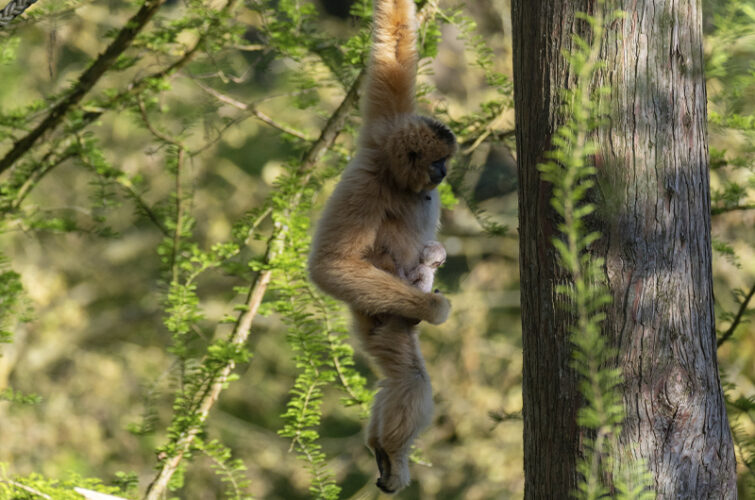
It’s not an April Fool’s joke… but an April gibbon. On 1 April 2026, a little yellow-cheeked gibbon was born at ZooParc de Beauval, the first baby of the pair formed by Maïka (female) and Hatin (male).
A rare and particularly memorable birth for the animal keepers in the Small Monkeys section, who are closely monitoring the first few days of this new arrival, still shy but already irresistible.
A birth discovered in the early hours
It was upon arriving at the building that the keepers discovered the baby, snuggled up against its mother.
“We discovered Maïka’s baby in the morning when we arrived at the building,” says Audrey, an animal keeper in the Small Monkeys section. “She must have given birth that morning. There were still some very fresh signs of the birth.”
For Maïka, this is her first baby. And yet, from the very first hours, the young female showed great confidence. “She had excellent instincts. She licked him straight away, he suckled, she lay down so he could reach her breast more easily… She’s a very good mum. For a first-timer, she’s doing very well.”
The keepers are watching the first few days of this newborn—still very shy, but already full of vitality—with emotion and care.
A tiny blonde “shrimp”, almost invisible against his mother
At birth, the young yellow-cheeked gibbon has very light fur, similar to his mother’s. A natural camouflage that sometimes makes him hard to spot for less attentive visitors.
“It really is a tiny little shrimp, so tiny, with big arms of course, like gibbons do,” smiles Audrey. “It’s blonde, in shades ranging from white to blonde. If you didn’t know there was a baby there, you might almost not see it, because it really blends in with its mother.”
Clinging to the lower part of Maïka’s belly, the little one never leaves her side—or rather, a tuft of fur. “He clings on really well to the fur and, even when Maïka moves, he stays firmly attached. He’s already quite strong.”
An acrobatic mum… and a baby who’s already following suit
What immediately impresses is seeing Maïka continue to move with disconcerting ease, baby on her belly. The yellow-cheeked gibbon moves by brachiation, which means it swings from branch to branch using its long arms, with impressive agility and speed.
And despite the very recent birth, nothing seems to slow the young mother down. “She moves just as she did before,” observes Audrey. “Sometimes she even does a spin, which gives us a bit of a fright! But in terms of their behaviour, everything’s fine. That’s how it’s supposed to be.”
For the baby, the first few months will be spent observing, nursing and learning from its mother, before setting out on its own explorations.
To mark the Paris 2024 Olympic and Paralympic Games, we produced a series entitled Les Jeux de Beauval, the second episode of which was devoted to the gibbon and its brachiation technique.
A couple as close as ever
Whilst Maïka takes care of most of the newborn’s needs, Hatin is never far away. For now, the male remains more of an observer, whilst the couple continues to function as before.
“He’s really just going about his own business on the sidelines. He’s watching,” explains Audrey. “But between them, nothing has changed: we still hear them both singing in the morning, they’re still curled up together, there’s still grooming…”
A detail that speaks volumes about the strength of the pair. Because among gibbons, morning vocalisations have real significance.
“The morning territorial call is to mark their territory, but not only that,” explains the keeper. “It also serves to strengthen the pair. Basically, it means they love each other very much!”
Their distinctive song had already been featured in an episode of ‘Brèves de Beauval’ dedicated to the pair.
An important birth for an endangered species
This birth is no coincidence: it is part of the European Endangered Species Programme (EEP), coordinated across zoos. The aim is to enable young gibbons to be born at the same time in several facilities, with a view to promoting future exchanges and genetic diversity.
For the stakes are high: the yellow-cheeked gibbon is classified as ‘endangered’ by the IUCN. Deforestation, poaching, habitat fragmentation in Vietnam and Cambodia… the threats are numerous. In this context, every birth in a zoo is a vital step towards the conservation of the species.
A baby still keeping a low profile… but already visible
Good news for visitors: even though it likes to keep a low profile, the young gibbon can already be spotted, provided you take the time to look. “Yes, I think you can really spot it now,” confirms Audrey. “When Maïka moves by brachiation, as it’s clinging under her belly, you can see it. It looks like a little blonde ball.”
The best time to try your luck? Late morning or late afternoon. “I’d say in the morning and around 5.30–6 pm. After having a bit to eat, they’re often very active.”
Springtime births at Beauval
This new arrival is part of an already particularly heart-warming spring at ZooParc de Beauval. It’s the perfect time to come and see, during your visit, the yellow-cheeked gibbon baby, as well as the young Indian rhinos, the little elephants Himba and Rosie, and even the golden monkey baby.
So many young animals offering visitors scenes of life full of tenderness, play and discovery… So many good reasons to come and experience Beauval right now. You can also discover our new attractions for 2026, Bucolia and The Red Lands, and admire the giant panda twins, Huanlili and Yuandudu, who have been growing up since 2021 in The Heights of China.