Surprise birth of a Grevy’s zebra as visitors looked on
Update – July 17
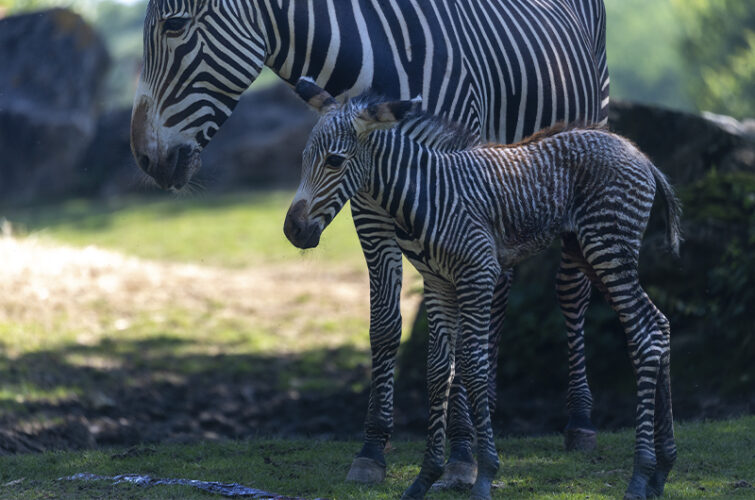
The male Grévy’s zebra foal born on June 18 is doing very well… and he now has a name! The keepers at Beauval ZooParc have chosen to call him Léon, in tribute to his father, Napoléon, who passed away earlier this year, in 2026.
Born on May 28 (Iéna) and June 18 (Léon), our two zebra foals recently took their first steps together on the African Savannah. Accompanied by their mothers and watched closely by the animal care teams, the two young zebras sparked the curiosity of the giraffes, wildebeest, and the other animals roaming the plain. Relive this special moment by watching our video.
The Grévy’s zebra family is growing at ZooParc de Beauval. On Thursday 18 June at 10.15 am, a newborn was born in the African Savannah, watched in wonder by visitors and then by the animal care team, who were quickly alerted.
The foal is the first baby for Martie, a female born at Beauval in 2020. Its father is Napoléon, the group’s iconic male who passed away on 2 February. It is a particularly symbolic birth for the keepers. “It’s a bit like the legacy the male left us before he passed away. We still have a little bit of him with us,” says Marine, an animal keeper at ZooParc de Beauval.
Check out the footage of the little zebra in our video!
A second piece of good news for this species in less than a month
This new birth comes less than a month after that of Iéna, a young female born on 28 May, the daughter of the female Max and the male Napoléon. The two young zebras will therefore grow up together on the vast 3-hectare plain, under the watchful eye of their mothers and the animal care teams.
Her name refers to the Battle of Jena, won by Napoleon in 1806. This choice was made by the keepers as a tribute to the male. The newborn’s name will be chosen by the keepers in the coming days. As with Iéna, it could in turn pay tribute to Napoleon, the sire of the last two zebra foals born at Beauval. Apart from the newborn, the African Savannah group consists of four females: Nora, Max, Martie and Iéna. A male named Drogo is also present in the camel enclosure.
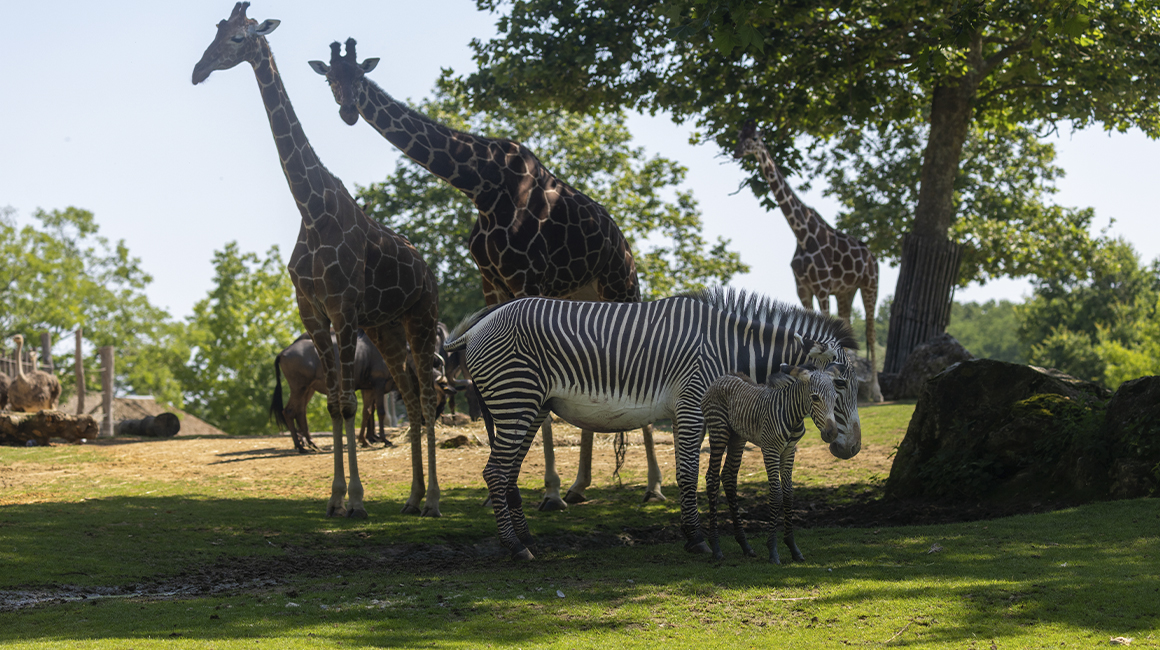
The other animals in the Savannah seemed intrigued by this newcomer
An unexpected birth so early
Although the team of keepers knew that Martie was pregnant, there was no indication that she was about to give birth. “There were no warning signs: no swollen udders, no particularly large belly, and no contractions observed this morning. We took her out as we would on any normal day,” explains Marine.
At around 10 o’clock, several visitors alerted the keepers: a female zebra was giving birth on the plain. When the team arrived on the scene, the foal had only just been born.
At birth, the newborn was still covered in its amniotic sac.
“As this is her first foal, we didn’t know how Martie would react. But she took an interest straight away and showed the right instincts. She wasn’t always very gentle, but that’s to be expected. She was encouraging him to stand up, and in doing so, she managed to remove the sac that was still covering him,” says the keeper. Fifteen minutes after his birth, the young zebra was already standing.
“I cried with emotion – it was such a beautiful sight”
Among those privileged to witness this event was Stéphanie, who had come from Clermont-Ferrand to spend a week at Beauval. “I saw the zebra mum lying down and the tip of the placenta coming out. I stopped and watched the baby take its first steps,” she says, still visibly moved.
An extraordinary moment that brought tears to her eyes. “I cried with emotion – it was such a beautiful sight.” ” The visitor was also able to observe the reactions of the other animals in the African Savannah. “The giraffes came over, very curious. The ostriches came to have a look, and the wildebeest seemed particularly intrigued by this newcomer.” Despite this general curiosity, Martie quickly demonstrated her maternal instincts.
“She was very protective right from the start,” observes Nathalie. A view shared by Marine: “It’s her first calf, but she’s had the right instincts and reflexes as a mother. She’s looking after it very well.”
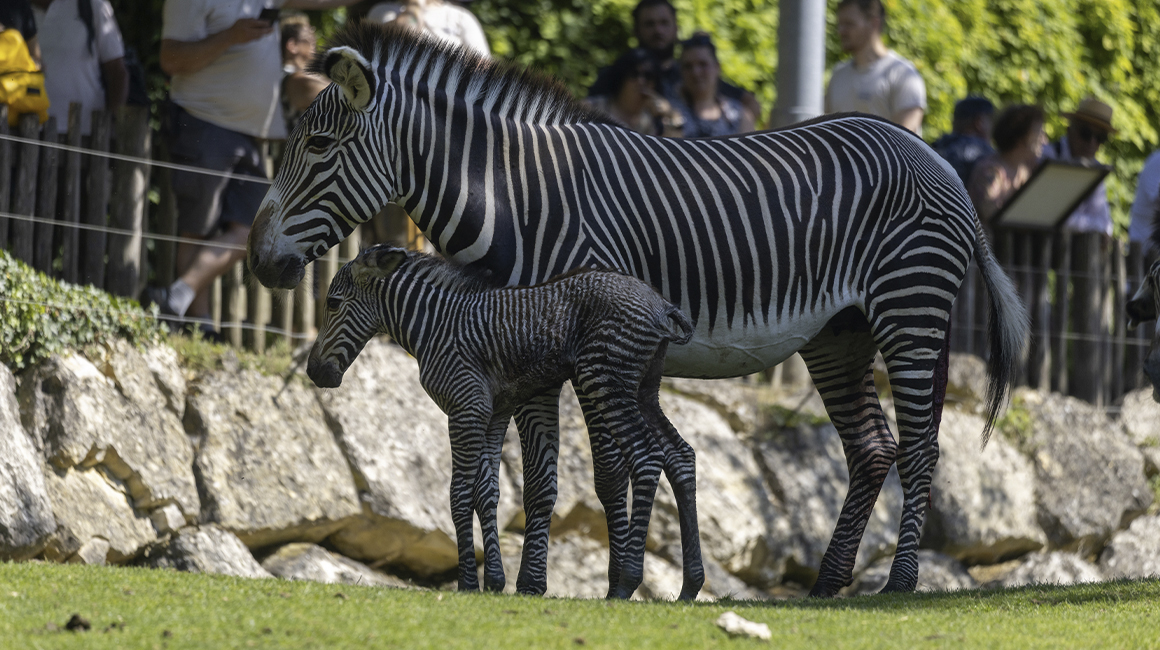
The baby was born in front of visitors
From one birth to the next, and still at Beauval
Born at ZooParc de Beauval on 13 June 2020, Martie has grown up well since then. In a video posted at the time on the ZooParc’s social media channels, she can be seen taking her first steps and frolicking with her mother Wanda just a few hours after her birth. Six years later, it is her turn to discover the joys of motherhood with her very first baby.
Reproduction in Grévy’s zebras
Grévy’s zebras can breed throughout the year, although most mating takes place between July and November. After a gestation period of around 13 months, the female gives birth to a single foal. At birth, the foal has brownish stripes which gradually darken as it grows. It is very precocious, able to stand and walk within about twenty minutes of birth, and to run less than an hour later. During the first few days, the mother isolates herself in order to strengthen the bond with her foal and allow it to memorise her scent, her vocalisations and the unique pattern of her stripes. Females give birth to an average of one foal every two years.
A species classified as ‘Endangered’ and protected by conservation programmes
The Grévy’s zebra is now the most endangered zebra species in the world. Classified as ‘Endangered’ by the International Union for Conservation of Nature (IUCN), there are now just under 2,000 adult individuals remaining in the wild. Its decline is mainly linked to the loss and degradation of its habitat, competition with domestic livestock for access to resources, as well as poaching and certain diseases. To ensure its survival, numerous conservation programmes are being carried out in Kenya and Ethiopia, in collaboration with local communities.
Around 600 Grévy’s zebras live in zoos around the world. In Europe, it forms part of an EAZA ex-situ programme coordinated by Marwell Zoo in the United Kingdom. Zoos, including Beauval, are also participating in this effort through a European breeding programme aimed at maintaining a genetically viable population.
As part of the PICODE programme in Djibouti, supported by Beauval Nature, initiatives to protect natural habitats, raise awareness and conserve endangered species have been carried out, particularly in support of the Grévy’s zebra.
Two Grévy’s zebras from ZooParc de Beauval joined the DECAN sanctuary in 2009. They were joined in 2015 by three further individuals from Port Lympne Zoo in the United Kingdom, thereby helping to rebuild a population of this species in the Horn of Africa.