A second Indian rhino calf to kick off 2026 at Beauval
Update – 23 January 2026
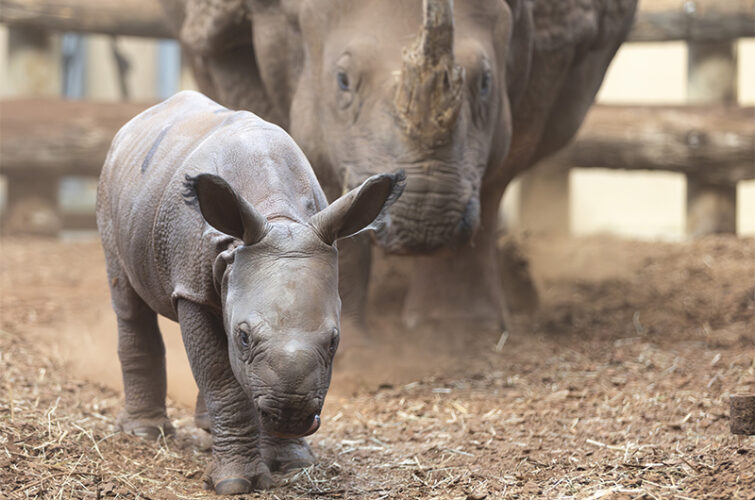
There is no longer any doubt: the Indian rhino calf is a female. The keepers have also chosen her name: Neytiri. A name inspired by the Na’vi dialect from the world of the film *Avatar*, which evokes nature and power… everything that this birth embodies.
_____________________________________
As the festive season drew to a gentle close and families savoured the final moments of the Christmas holidays, a very different story was quietly unfolding at ZooParc de Beauval.
On the night of 1
A surprise birth
There had been no indication that a birth was so imminent. The due date had been estimated as around 19 January, and the teams were still planning to swap Henna’s and Saathi’s indoor enclosures, so as to move the expectant mother into a specially fitted-out birthing pen to welcome her calf.
Admittedly, for the past few weeks, Henna had been more irritable than usual. Her udder seemed slightly saggy… but in Saathi’s case, that same sign had come to nothing for nearly two weeks. So, when a colleague called out to Madison that day: “Go and have a look at her, I think she’s behaving really strangely”, the keeper remained cautious.
“When in doubt, there’s no doubt… but personally, I didn’t think so. Her vulva looked normal, and she’d been behaving like that for a week…”
The next day, reality caught up with her.
The most wonderful way to wake up…
It is 11.30 pm on 1 January when Henna goes into labour.
At 11.40 pm, her baby is born.
At 12.30 am, he’s already standing up, wobbly but determined.
At 12.40 am, he moves closer to the teat for what looks very much like his first feed.
The first to discover the scene in the early hours of the morning is Florian, an animal keeper. Moments later, he calls Madison, who is still in shock.
“Florian called me in a panic. The baby was there!”
For the keepers, it came as a complete surprise. The start of the year has never been so intense.
An attentive mum, a baby full of promise
Henna knows her role well. Before this newborn, she had already given birth to Gainda in 2016, Anjali in 2019, and a cub that sadly died two days after its birth. Once again, the mother is proving to be extremely protective and attentive, drawing on all her experience to care for this new baby.
At birth, the little one weighed around 40 kilos. A small size, which is to be expected for a baby born nearly three weeks early, and slightly smaller than Bahïs, who was born at full term last September. Among its distinctive features: a corkscrew tail and a slightly asymmetrical mouth, which already make it instantly recognisable.
His sex remains a mystery for now. Madison has her own theory, but we’ll have to wait for microchipping and sex determination to confirm it. In the meantime, let the predictions begin!
As for his name, it will be chosen by the team: seven carers, seven suggestions, followed by a group vote.
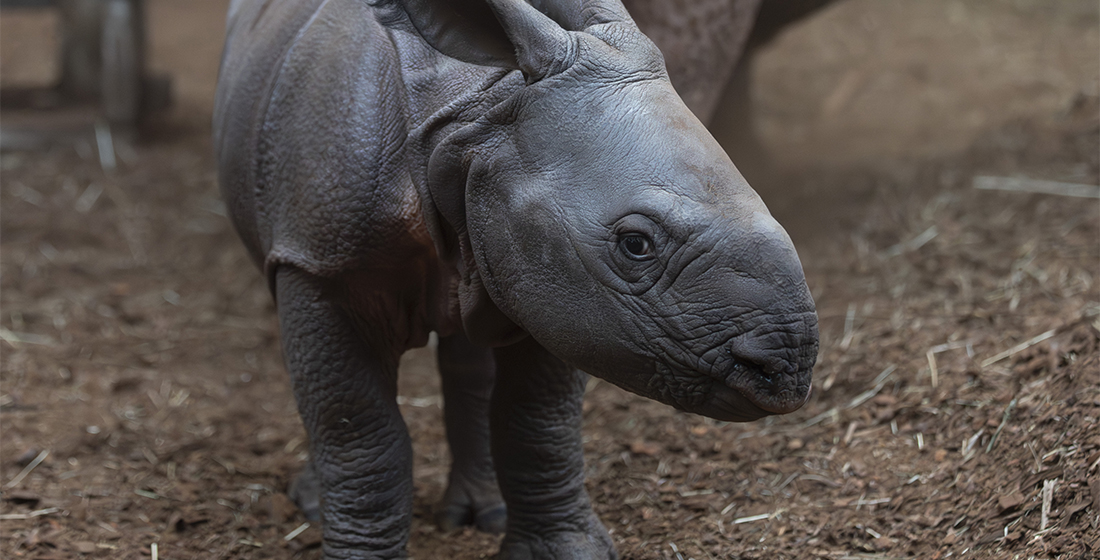
Her first outing in the open is expected in mid-February or March, once the temperatures have become milder.
A unique bond between carers and animals
At Beauval, the animals are much more than just residents. For the keepers, they are a real family. This birth is further proof of that: the emotion is palpable, the vigilance constant, the movements precise yet full of tenderness. A relationship built on mutual trust, forged day by day.
The baby rhino is already on display to visitors, in a pen facing the glass panels. Its first outing into the open is expected in mid-February or March, once the weather gets milder.
Madison says eagerly: “I can’t wait to put him together with Saathi and Bahïs… we hope to be able to do that within the next three months.”
A symbol of hope for a vulnerable species
The birth of this second Indian rhino calf in the space of a few months offers tremendous hope for the species, which is currently classified as ‘Vulnerable’ on the IUCN (International Union for Conservation of Nature) Red List.
Although the population has grown considerably in recent decades thanks to sustained conservation efforts, there are still around 4,000 Indian rhinos in the wild, found mainly in India and Nepal.
This species remains vulnerable: its natural habitat is constantly under threat from habitat loss linked to agricultural expansion and human encroachment, from poaching for the illegal horn trade, and from population fragmentation, which reduces their genetic diversity and resilience to disease and natural disasters.
Today, every birth counts. Every individual is precious.
By sponsoring Henna, you are making a direct contribution to the protection of biodiversity as a whole, to conservation programmes, to animal welfare, and to raising public awareness of the challenges threatening many species around the world.
And what’s the latest on Bahïs?
As for Bahïs, born on 14 September 2025, she is doing wonderfully well. She already weighed 141 kg on 4 November, and at this age, a young Indian rhinoceros gains an average of 5 kg every two days. So she’s now very likely approaching 300 kg! Impressive growth, reflecting the wonderful momentum currently driving the Beauval Indian rhino family.
A year that begins in the spirit of life, hope… and emotion.