World Great Ape Day: let’s (re)discover our precious cousins
Every year on 24 June, we celebrate World Great Apes Day. Whilst they fascinate us with their intelligence, their gaze and their expressions, gorillas, chimpanzees, orangutans and gibbons are nonetheless under threat: alongside our association Beauval Nature, the ZooParc de Beauval is committed to their conservation. In this article, we invite you to (re)discover these fascinating animals, the various threats they face and the measures put in place to protect them.
I’m coming to see the great apes
What is a great ape?
Hominoids, more commonly known as great apes, comprise several species with remarkable characteristics. What do they have in common? A particularly well-developed brain, for one thing, but also the absence of a tail, which sets them apart from other primates: this distinctive feature also affects the rest of their physique. Indeed, their torso and limbs are called upon to perform movements that would normally be carried out by the tail.
A brief overview of the great apes:
- The bonobo, a species you won’t be able to see at Beauval. Endemic to the Democratic Republic of the Congo, it is also the species closest to humans: it shares 98.7 per cent of its DNA with us.
- The chimpanzee, which inhabits the tropical forests and mountains of Central and West Africa. They display great intelligence: for example, they have an excellent memory, which enables them to recognise individuals they haven’t seen for a long time. Some have even learnt sign language!
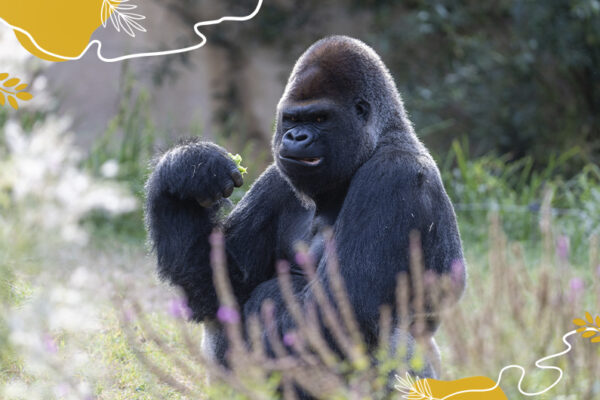
To find out more at Beauval, head to the Chimpanzee and Orangutan House, home to our group of 14 individuals. - The gorilla is one of the largest primates. Males are, in fact, much more imposing: they can weigh up to 230 kg, compared with barely 100 kg for females. This difference between males and females, known as sexual dimorphism, becomes apparent during adolescence – around the age of 11 or 12 for males and 7 or 8 for females. There are two species of gorilla: the eastern gorilla and the western gorilla. At Beauval, it is the latter that you can see, and more specifically the western lowland gorilla subspecies, featuring:
- Our group of single males, comprising Asato and his five sons, on their island opposite the chimpanzees’ enclosure.
- Our breeding group, comprising the male Euro and the females Kabinda, Sheila, Sawa and Anandi, in the Gorilla House.
- The orangutan, which is not only the largest of Asia’s primates but also the largest tree-dwelling mammal. Diurnal by nature, it rests each day in a nest made of intertwined vegetation, which it builds at a height of 12 to 18 metres. Its extremely long arms, with a wingspan of two metres for males, help it to move easily through the trees.
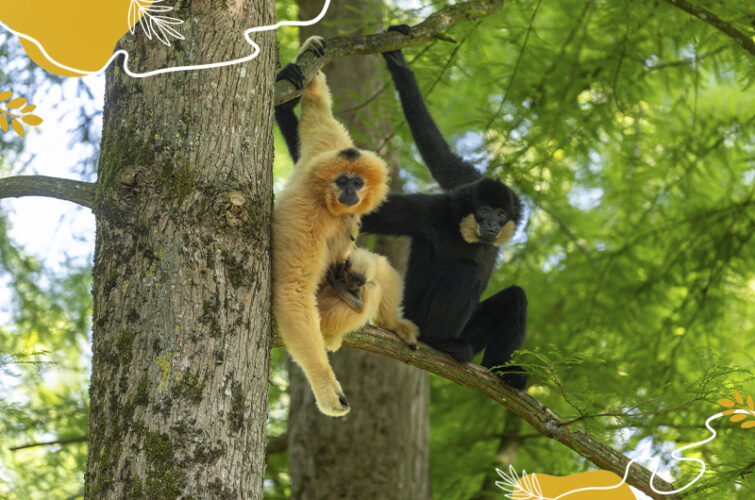
There are three species of orangutan: the Tapanuli orangutan, the Sumatran orangutan and the Bornean orangutan. At Beauval, it is the latter that you can see in the Chimpanzee and Orangutan House. - The gibbon, an Asian primate comprising twenty different species. They are the primates best adapted to moving by brachiation, that is, using the strength of their arms. This allows them to move quickly through the canopy and even make leaps of up to 10 metres to move from one tree to another.
At Beauval, meet our pair of red-tufted gibbons, Hatin and Maika, as well as their baby, born on 1 April 2026 in the Historic Alley.
And the last of the great apes… is Man!
Indeed, whilst it is often said that Man is descended from apes, this is not strictly true: in fact, Man is one. Homo sapiens, the scientific name for our species, does indeed belong to the great ape family: it is, in fact, the only one that is not threatened with extinction.
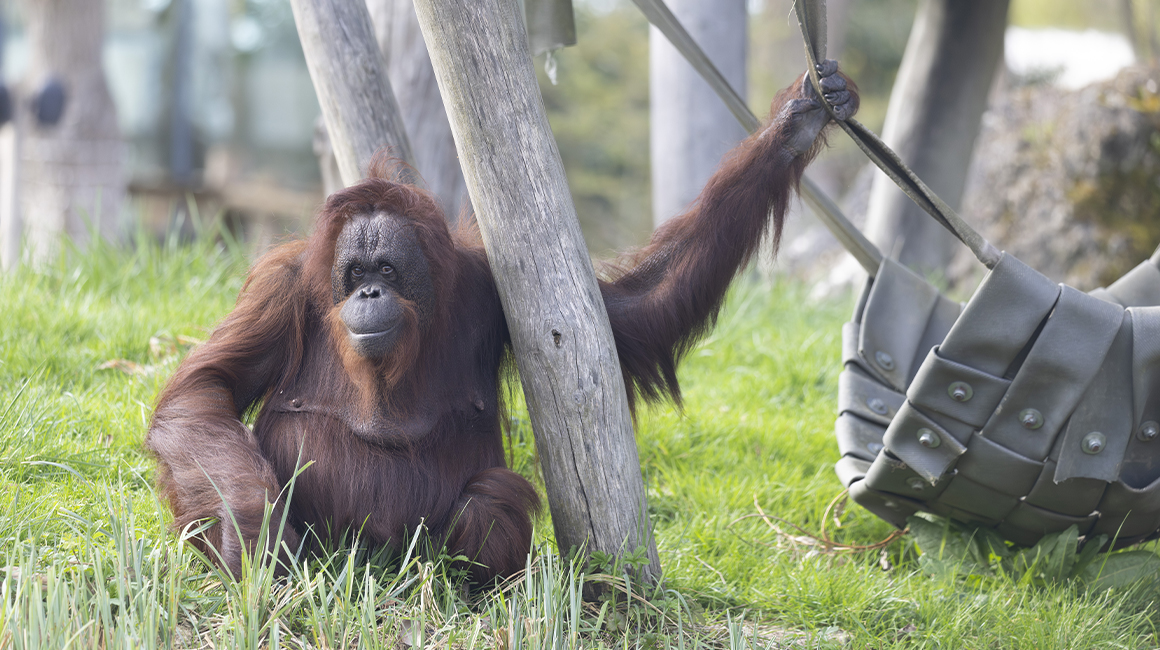
Nuninka, a female orangutan on display at Beauval
Great apes… threatened with extinction
If we set aside the human species, all great apes are currently threatened with extinction across the planet. Poaching, deforestation, the transmission of diseases, conflicts with humans… these are all threats weighing on these animals that could lead to their disappearance. Yet these primates are as fascinating as they are essential: the chimpanzee, for example, plays a vital role in helping to disperse seeds within its ecosystem through the fruit it eats.
Did you know? Ecotourism, which allows people to encounter these primates in a responsible way, could help to promote their protection, whilst providing significant income for local communities. You can, for example, enjoy this experience with HELP Congo, a conservation organisation working to protect chimpanzees and supported by our organisation, Beauval Nature.
Find out more about ecotourism with HELP Congo
How can we protect great apes?
You too can play a part in the conservation of great apes. Taking your old mobile phone to the collection point at the South Entrance of ZooParc is already a step in the right direction: this helps to recycle coltan, a mineral found in particular in the forests of the Congo, home to gorillas, chimpanzees and bonobos, and whose mining leads to severe deforestation.
You can also choose to make a donation to our organisation, Beauval Nature, which supports several programmes dedicated to the conservation of great apes.
In Africa, it has provided support to:
- The HELP Congo organisation, which works in Conkouati-Douli National Park, not only to protect the Central African chimpanzee but also the Western lowland gorilla. For example, over the past three decades, more than 110 chimpanzees have been rescued by the organisation.
- The Jane Goodall Institute, which takes in orphaned chimpanzees, mainly those seized from private individuals. Housed at the Tchimpounga sanctuary, they are cared for by qualified vets and carers. The aim is to help them become independent so that they can be reintroduced into the 7,000-hectare reserve surrounding the sanctuary.
- To the conservation organisation Friends of the Bonobos, which takes in orphaned bonobos. Their work is multifaceted: reintroducing these animals to their natural habitat, combating poaching, supporting the economic development of local communities, and raising awareness of bonobos and the threats to their survival. Since 2002, hundreds of these primates have been rescued and cared for, and currently, 70 individuals of all ages live in densely wooded enclosures within the 30-hectare sanctuary.
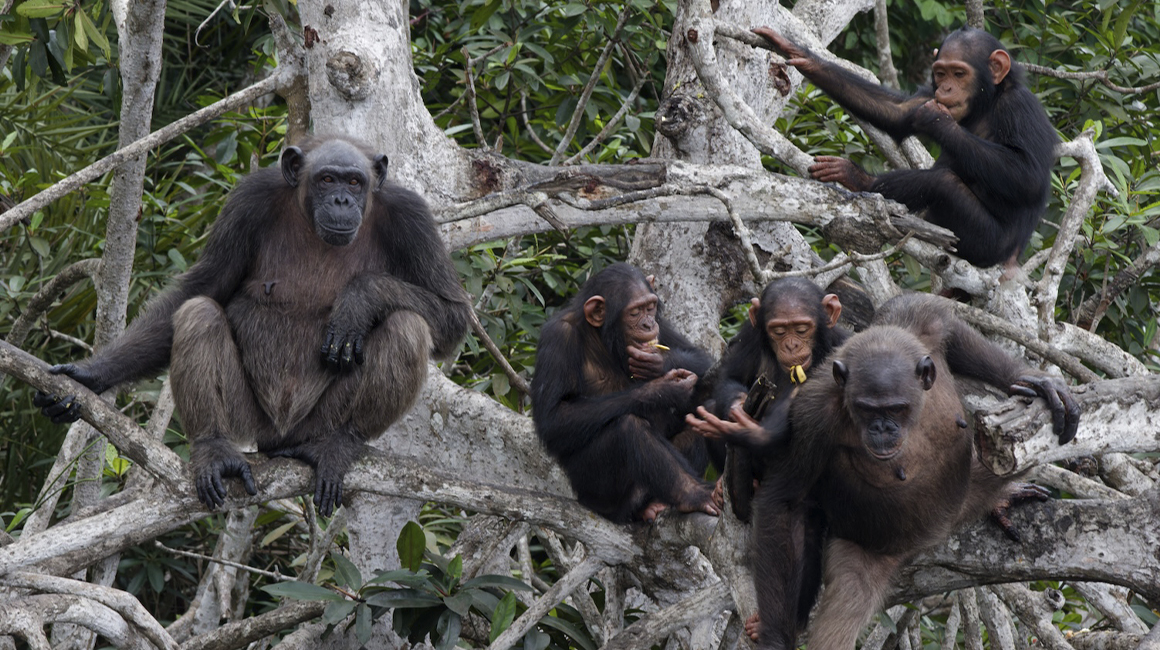
Chimpanzees from the HELP Congo programme
In Asia, Beauval Nature has donated nearly 500,000 euros to support the French organisation HUTAN. The organisation has set up a research station in Borneo to study how orangutans adapt to life within oil palm plantations. Each year, a number of initiatives are carried out: monitoring biodiversity, orangutan populations and their nests; planting trees; organising patrols to protect the forests; and raising awareness…
Beauval Nature and the ZooParc de Beauval have also been involved in the reintroduction of gorillas born in zoos. Mayombé, a female born at Beauval, was successfully reintroduced in 2019 and gave birth to a baby girl, Taàli, who celebrated her fifth birthday on 13 June. This birth offers hope for the western gorilla, a species classified as critically endangered, as this baby is the first to be born in the wild to two gorillas originally from zoos.
Your donation can also take the form of a sponsorship. By sponsoring Tumba, our male chimpanzee, Asato, our male gorilla, or even our group of Bornean orangutans, you’ll forge a special bond with these iconic animals, whilst helping to preserve biodiversity.