A young, orphaned red kangaroo taken into care at the veterinary clinic
Update: 8 October
The young kangaroo is continuing to grow at her own pace at Les Terres Rouges
Good news: after several weeks at the veterinary clinic, the young kangaroo returned to Les Terres Rouges on 7 September.
She is now continuing to develop there in a heated enclosure specially fitted out for her. The little one now weighs 3.15 kg and is starting to come out of her pouch more regularly to explore her surroundings and take small hops.
Her diet is also changing. Still being bottle-fed, the young kangaroo is gradually being introduced to solid food, consisting mainly of fresh grass, pellets and vegetables. Her fabric pouches are replaced and washed every day to ensure she has a clean and comfortable environment.
Another important milestone: the young kangaroo now shares her enclosure with Bayali, a 6-year-old female, and her joey. Curious, she approaches them of her own accord and is gradually getting used to their presence. Interactions are developing gradually, at each individual’s own pace. This initial cohabitation should, in particular, help her to observe the behaviour of her fellow kangaroos and continue her learning process before eventually joining the whole group.
You might even spot her from the Terres Rouges footbridge. With a bit of luck, you might see her little head peeking out of her fabric pouch or spot her as she ventures out to explore her surroundings.
She doesn’t have a name yet… but we may well need your help very soon to choose one for her! Follow Beauval on social media so you don’t miss the next chapter in her story.
On your next visit, head to the Terres Rouges to try and spot her and observe the female and young red kangaroos, as well as many other Australian species, including wombats.
I’m coming to see the kangaroos
______________________________________________________________
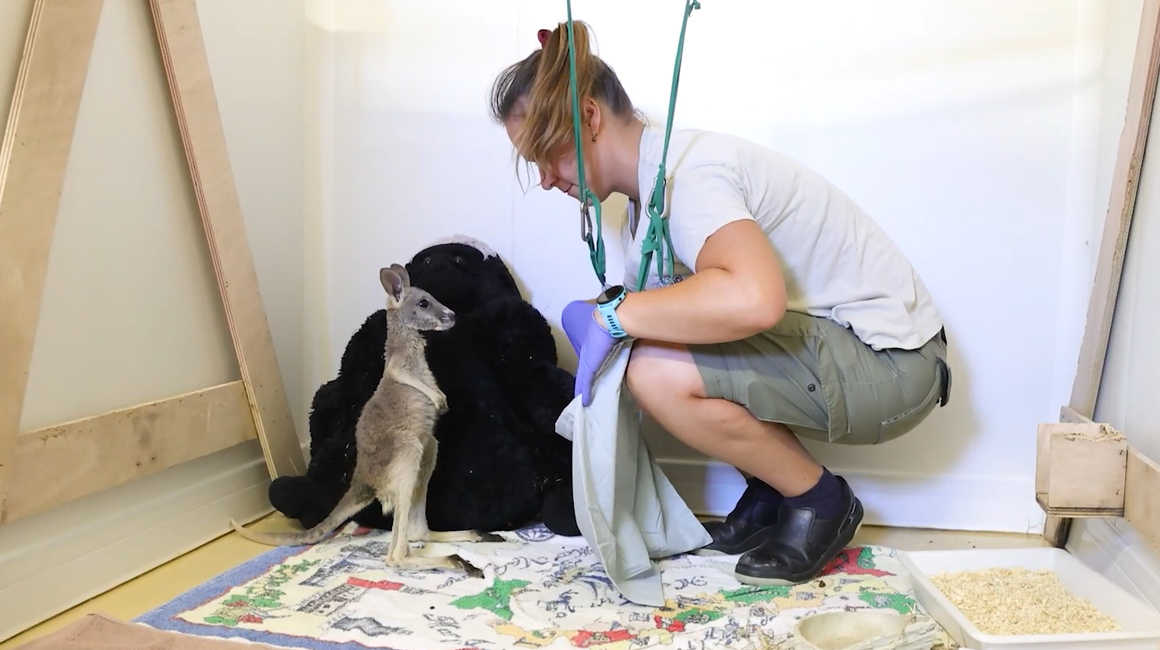
Born last February, a young female red kangaroo has sadly lost her mother, who died following an infection. Still in her mother’s pouch and dependent on her for food and protection, the joey was transferred to the veterinary clinic at ZooParc de Beauval. For several weeks now, the teams have been taking turns to provide her with all the necessary care and give her the best chance of continuing to grow.
Watch the video for a behind-the-scenes look at her care and the progress made by the young kangaroo.
Care tailored to her needs
When she was removed from her mother’s pouch, the young kangaroo was suffering from hypothermia and required veterinary care. As she had not yet been weaned, she also needed to be kept at a suitable temperature, which the kangaroo enclosure was unable to guarantee.
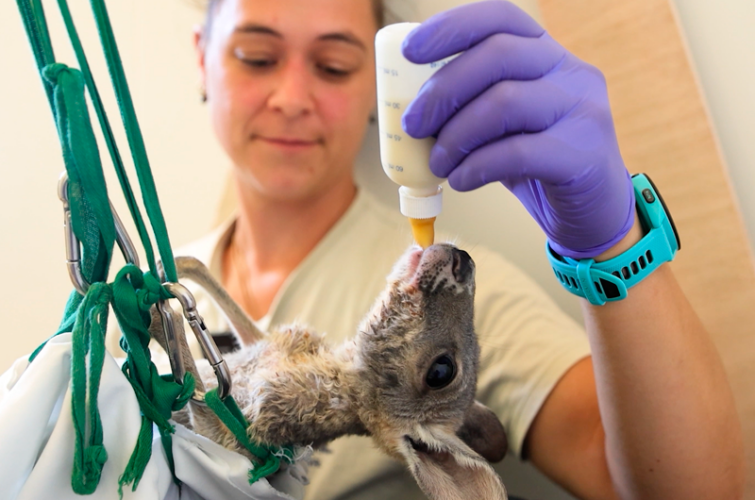
She was therefore transferred to the veterinary clinic, where the teams put in place a specific protocol to rear her and closely monitor her health. As she was making good progress, this care continued at the clinic. There, she is fed several bottles a day and is gradually becoming more independent.
A pouch made especially for her
To replicate as closely as possible the position, warmth and protection provided by her mother’s pouch, the team made her a fabric pouch. Snug and warm in this cosy cocoon, the little one can settle into the position in which she has felt most comfortable since the start of her care.
Mealtimes are tailored to her own pace. When she falls asleep whilst feeding, the staff pause the feed and return to offer her milk a little later if necessary. Feeding, monitoring her behaviour and tracking her growth thus form the rhythm of her days at the clinic.
Limited contact to prepare her for a return to the group
Despite the attentive care she receives, interactions with the staff are deliberately limited to essential moments, particularly during bottle-feeding. This precaution helps prevent the young kangaroo from becoming overly accustomed to humans and forming an excessive attachment to them.
The aim is for her to rejoin the other kangaroos as soon as she has been weaned and is sufficiently independent. It will still be a few weeks before she can be reintegrated into the group. Until then, the teams will continue to monitor her progress with the utmost care.
An amazing start to life in the mother’s pouch
In red kangaroos, gestation lasts only about a month. At birth, the joey is still tiny: blind, hairless and very underdeveloped, it measures about 2 cm and weighs less than a gram. It finds its way into its mother’s pouch on its own by clinging to her fur, then latches onto a teat to continue its development.
Over the months, the joey begins to emerge from the pouch from time to time to explore its surroundings, before leaving it for good at around 7 to 8 months of age. It continues, however, to suckle from its mother for several months before being gradually weaned.
Kangaroo reproduction has another remarkable feature: a female can simultaneously have one joey out of the pouch that is still being suckled, another in the pouch, and an embryo whose development is temporarily suspended. Thanks to her separate teats, she can even produce milk at the same time, the composition of which is tailored to the developmental stage of each of her young.
Meet the red kangaroos at the Terres Rouges
At Beauval, female red kangaroos and their young roam the Terres Rouges, one of the new attractions for 2026. You’ll also be able to see Parma wallabies, rock wallabies, emus and, for the first time in France, wombats! A group of male red kangaroos can be seen near the Conservation Bridge (no. 45 on the map). Come and discover this fascinating Australian wildlife on your next visit to the ZooParc.