Birth of a baby elephant at Beauval: N’Dala’s baby is doing well!
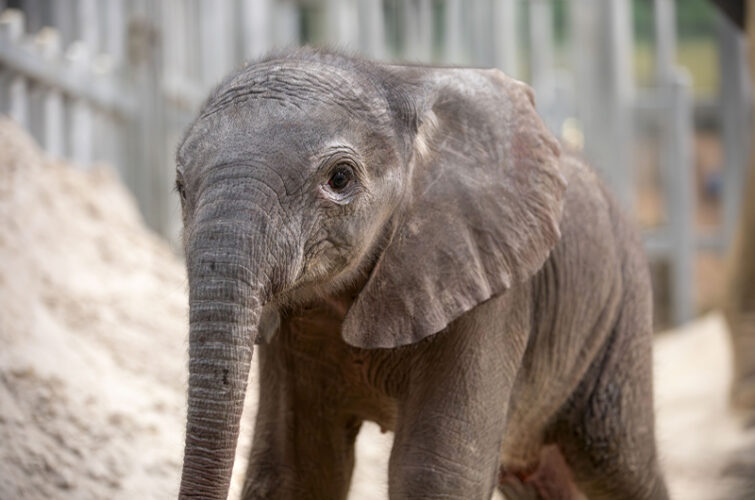
There’s great excitement at the ZooParc de Beauval!
N’Dala (aged 37) has given birth to a baby elephant at the Maison des Éléphants after a gestation period of more than 21 months. It is a little female and she is doing very well, as is her mum. Her name will be chosen by the keepers in the coming days.
Eagerly awaited by the teams, this little baby marks a historic moment: no baby elephant had been born at Beauval for 13 years. The first and last elephant birth at Beauval dates back to 20 July 2012, when N’Dala gave birth to a baby elephant named Rungwe.
On 3 December, we announced that N’Dala and Ashanti were both expecting. Whilst the first of the two expected calves has just been born, Ashanti is still pregnant and under close observation.
Akili, the only male in the elephant herd at Beauval, is the father of both babies: the little female born last night and the one (male or female) that Ashanti is still expecting.
Round-the-clock monitoring began on Wednesday
Night-time monitoring was initiated by the animal care team on Wednesday 11 February, following a drop in N’Dala’s progesterone levels – a biological indicator signalling an imminent birth. This arrangement ensures a continuous presence of keepers to monitor the progress of the birth, observe the first interactions between mother and baby, and intervene quickly if necessary.
Ashanti (aged 23), whose hormone levels began to fall at the start of the week, also remains under close observation as she awaits her own birth. This will be her first birth, unlike N’Dala, who is already an experienced mother.
N’Dala, a blind mother who is coping very well
The fact that N’Dala is blind is of no concern to either the keepers or the vets. Her loss of sight developed gradually, a few years after Rungwe’s birth. It was not the result of an accident, a specific injury or an age-related condition: her eye problems developed gradually, with no specific cause identified, until they severely impaired her sight. She probably still perceives certain variations in light, but can no longer really make out shapes.
Accustomed to this situation, N’Dala moves with confidence in an environment she knows perfectly well. She uses her trunk as a tool for exploration and guidance, relying mainly on touch and smell. With her calf, she naturally finds her bearings and guides her, particularly during the first feedings. Her experience and memory of the surroundings are invaluable assets in calmly guiding her baby through her first days of life.
Watch the video of this exceptional birth, then read the full story below.
The story of a much-anticipated birth
It all began at 8.46 pm on 14 February, Valentine’s Day, when the teams were alerted that N’Dala’s waters had broken. Within minutes, keepers, on-call vets and managers were on the scene. It looked set to be a long night.
Positioned in two separate rooms so as not to disturb N’Dala, the teams monitored the progress of labour via CCTV cameras installed in the birthing pen, at the elephant’s eye level and several metres above to provide a bird’s-eye view. Despite her waters having broken, the contractions remained few and far between. The hours passed without any real visible progress.
“As we watched the hours go by without any clear signs of labour, our concern grew: we could see that things weren’t progressing,” explains Baptiste Demarsan, head of the Herbivore Department at ZooParc de Beauval. “When we reached the four-hour mark after her waters had broken, we knew we had to intervene to understand why the birth wasn’t progressing.”
At around one o’clock in the morning, it was decided to carry out an initial veterinary intervention. To enable a thorough examination in complete safety — for both the animal and the teams — a secure restraint system was temporarily put in place to limit her movements. This supervised procedure allowed the team to take a blood sample, carry out an ultrasound scan and administer stimulation. The vets were able to confirm that the baby was alive via the ultrasound scan, having observed signs of blood flow. An injection of oxytocin was then administered to restart the contractions.
At around 3 am, as the birth had still not taken place despite more intense efforts, a second intervention was necessary. As part of the same safety protocol, N’Dala was once again stabilised to allow for further stimulation. At that point, the team was preparing to consider a delicate surgical procedure if the situation did not improve.
“At that moment, we were all focused on saving the mother. We didn’t necessarily think the baby would survive,” says Baptiste. “We had no definite information: the ultrasound didn’t show that he was dead, but it didn’t confirm he was alive either. So we focused on the essentials.”
Eventually, labour picked up pace and the baby was born at 4.02 am.
Initially unresponsive, the baby was immediately attended to, stimulated and cleared of mucus. When he took his first breath through the fallopian tube, a huge wave of relief swept through the building.
“The first thing we saw was the proboscis emerging, all limp, showing no reaction. Then, in the minutes that followed, it contracted and began to straighten… and that’s when we realised he was alive,” says Baptiste. “Needless to say, there was a real sense of euphoria in that moment, even though we remained completely focused on the tasks at hand.”
Once the safety equipment had been removed, N’Dala rejoined her calf. After a few tense seconds — just long enough for her to locate him — she vigorously stimulated him, as female elephants do, before sheltering him between her front legs. The emotion was overwhelming at this moment, which had been awaited for thirteen years. Some keepers, vets and managers were unable to hold back their tears, releasing the tension that had built up over many long hours.
“We went through every emotion in the space of a few hours…”, summarised the head of the Herbivore Department.
And beyond the emotional rollercoaster, the strength of the team was crucial: “Everyone knew exactly what they had to do. We didn’t even look at one another: it all happened naturally,” emphasised Baptiste. “ The vets were exceptional: well-prepared, on the spot, and taking the right actions. And as for the carers, everyone rose to the occasion.”
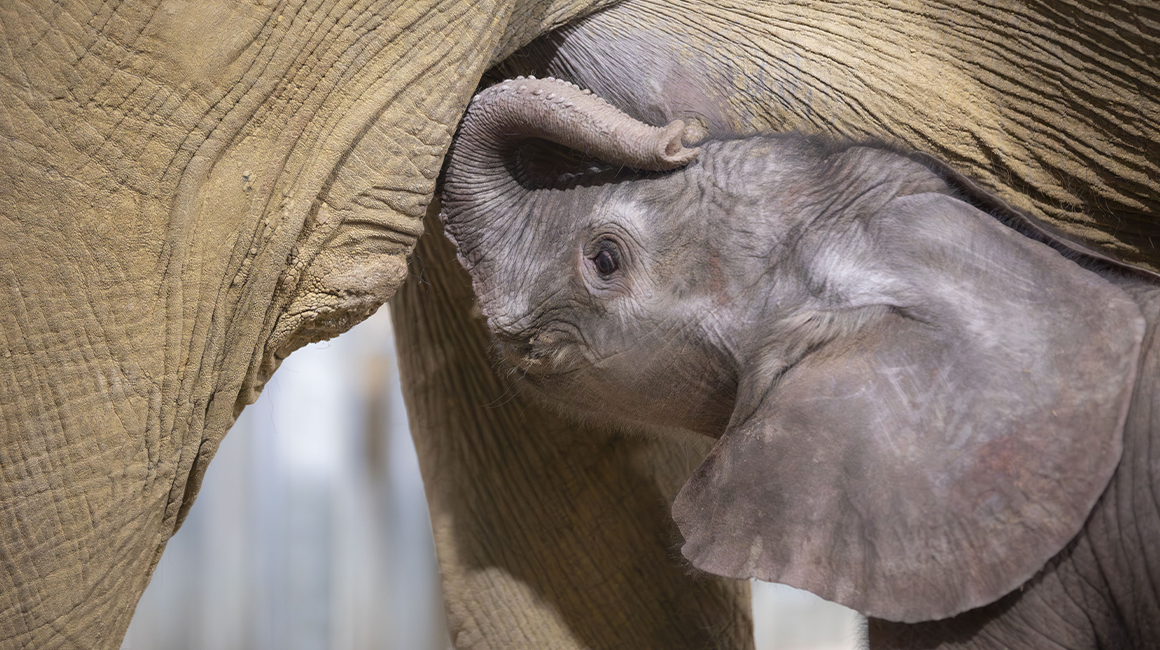
A crucial moment: the first feeds
A healthy baby
At birth, a baby elephant usually weighs around 100 kg. Initial observations are reassuring, and the teams are closely monitoring these crucial moments: standing up for the first time, the first feeds and the bond between mother and calf.
Standing up refers to the moment when a newborn animal stands up for the first time. For elephants, this is a very important stage in the first few hours of life.
Why is this crucial?
- It shows that the calf has good muscle tone.
- It allows the calf to reach the teats for its first feed.
- It is a key indicator of neurological and locomotor vitality.
A historic event for Beauval and important for the conservation of the species
The last elephant birth at Beauval was on 20 July 2012, with the birth of Rungwe. Since then, Rungwe has joined other European zoos as part of the breeding programme: transferred in 2018 to Magdeburg Zoo (Germany), he has been living at Győr Zoo in Hungary since 2021.
The African savannah elephant is classified as ‘Endangered’ on the IUCN Red List. This birth is therefore excellent news for the European breeding programme, which aims to ensure a viable and genetically diverse population in Europe.
Can we see the baby?
With a bit of luck, visitors will be able to catch a glimpse of the little female inside the Elephant House, in a quiet area suited to her first few days of life. Her first outings onto the Elephant Plain will, of course, depend on how she is developing and on the weather conditions.
You can sponsor the elephant herd at Beauval
At ZooParc de Beauval, seven females — including the very recently born calf — and one male, Akili, roam across three plains totalling 6 hectares: this is the largest living space for elephants in France. A superb facility designed with their wellbeing in mind.
You can sponsor the elephant herd and contribute directly to the conservation of endangered species around the world.
Sponsorship is a donation to the Beauval Nature charity, 66% of which is tax-deductible.