The emotional return of a golden lion tamarin to Beauval eleven years after it was stolen
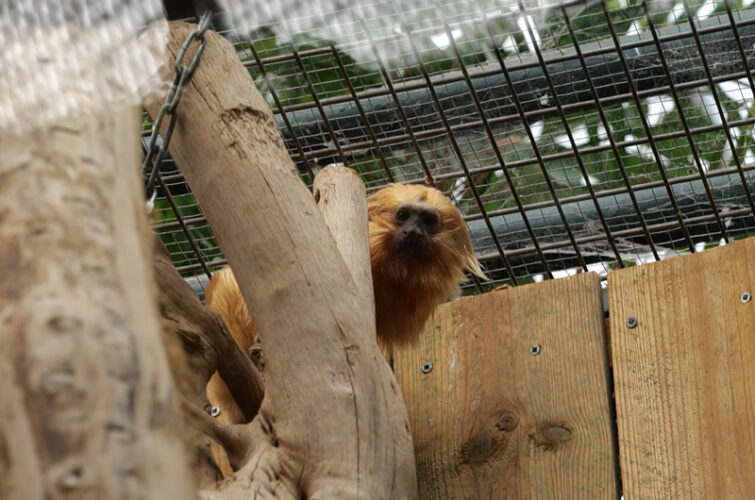
A touching moment. On Thursday 28 May 2026, a female golden lion tamarin returned to ZooParc de Beauval, eleven years after being stolen in May 2015. Found alive in Slovakia in 2023, the animal was finally able to be repatriated to France after several years of legal proceedings.
It was a particularly moving moment for the ZooParc teams and for Rodolphe Delord, Director General of ZooParc de Beauval, who travelled in person to the rescue centre at Bojnice Zoo in Slovakia, where the animal had been cared for since its seizure. She is a female now aged 12 and named Zlatka, which means “little golden one” in Slovak, by the teams who have been caring for her over the past few months. Born in Beauval in July 2013, the female golden lion tamarin was not yet two years old when she was stolen in 2015.
“When we learnt that one of the tamarins was still alive, after all these years, the emotion was overwhelming. We had finally lost hope,” says Rodolphe Delord today.
A night that left a deep mark on Beauval
During the night of 9–10 May 2015, intruders broke into the zoo. The thieves made off with seven golden lion tamarins and ten silver marmosets, two endangered species included in international conservation programmes. For the animal care teams at ZooParc de Beauval, the disappearance of these small primates had deeply shaken the staff.
At the time, the theft had caused a huge outcry far beyond the ZooParc. Thousands of messages of support had flooded social media and the press. The hashtag #RendezLesSinges had quickly risen to become one of the most shared topics on Twitter. On 12 May 2015, it even reached the top of the ‘trending topics’ in France on Twitter, the result of a huge wave of outrage. The disappearance of these small primates had deeply moved the general public, who rallied in the hope of finding them.
Despite nearly twenty months of investigation involving the gendarmerie and several international organisations, the animals were never found and the case was finally closed in 2017.
An unexpected twist ten years later
The case took a spectacular turn, however, when a female golden lion tamarin was discovered in 2023 at a private residence in Slovakia. Several months later, thanks to her microchip, the French Office for Biodiversity (OFB) was able to confirm with certainty to Rodolphe Delord that this was indeed one of the animals stolen from Beauval ten years earlier.
The animal is also believed to have passed through Germany, where a second microchip was reportedly implanted to conceal its origin.
“Our electronic identification system has made it possible to prove beyond any doubt that this was indeed an animal born at Beauval. Without this traceability, it would have been impossible to track it down,” emphasises Rodolphe Delord.
The tamarin’s return to Beauval has stirred strong emotions among the animal care teams, particularly among certain keepers and managers who have been at the ZooParc de Beauval for over ten years and who witnessed the theft in 2015. “It is both a source of immense joy and great sadness. Finding an animal alive after ten years is exceptional, but it also reminds us that the others remain missing. Two families have been separated and some individuals have probably died,” he continues.
A healthy female
After her seizure in Slovakia, the female had been placed in a rescue centre where she was kept alone, with only visual contact with another primate of a different species.
On her arrival at Beauval, the animal underwent veterinary and behavioural examinations to assess her state of health and her ability to live once again with other golden lion tamarins. After ten years away from her own kind, the question was whether reintegration into a group was possible.
The veterinary examinations confirmed that Zlatka was in good health. Now housed in a dedicated area within the Chimpanzee and Orangutan House, she is visible to the public whilst remaining under the close supervision of the animal care teams.
The keepers will now observe her behaviour to assess the possibilities of her living alongside other primates. However, after more than ten years spent away from her own kind, integration into a group of golden lion tamarins appears to be complex, as this species generally lives in small family groups that are reluctant to accept new individuals. Depending on her progress and behaviour, however, contact with other species of small primates, such as pygmy marmosets, could nevertheless be considered in the coming months.
An endangered species and victim of wildlife trafficking
Native to the tropical forests of Brazil, the golden lion tamarin is an endangered species that is the focus of major international conservation programmes. The destruction of its natural habitat and wildlife trafficking have contributed significantly to its decline over the past few decades.
Wildlife trafficking is now one of the largest illegal trades in the world. Primates, reptiles and exotic birds regularly feed international underground networks. In this case, the animal’s electronic identification played a vital role in enabling its return to Beauval.
“These animals are of immense value to biodiversity, but have no market value in our eyes. They are not bought or sold: they are exchanged as part of international conservation programmes,” says Rodolphe Delord.
CITES and the OFB mobilised against wildlife trafficking
To combat the illegal trade in wild animals, more than 180 countries now apply the Washington Convention, better known as CITES. This international agreement strictly regulates trade in endangered species to limit their extinction in the wild.
In France, this fight is led in particular by the French Biodiversity Agency (OFB), whose specialist officers monitor the keeping, transport and trade of protected animals.
In this case, the tamarin’s electronic identification played a decisive role. Despite the addition of a second microchip intended to conceal its origin, the authorities were able to confirm with certainty that it was indeed an animal born at Beauval and arrange for its return.
Raising awareness to better protect
Beyond the investigation and repatriation, this story serves as a reminder of the importance of raising public awareness about wildlife trafficking. Behind the purchase of an exotic animal often lie illegal networks, animal suffering and a direct impact on species already vulnerable in their natural habitats.
“If this story can help remind the public that these animals have no place in illegal trade networks or in private homes, then this return will also have a positive impact on conservation,” concludes Rodolphe Delord.
Golden lion tamarins to discover at ZooParc de Beauval
The ZooParc de Beauval now houses several golden lion tamarins, which can be seen in the Equatorial Dome, on the island near the manatee pool.
“Visitors can see Maya, a female who arrived at Beauval in 2015 to be reunited with Maceio shortly after the golden lion tamarins were stolen. At the time, Maceio was the only individual of this species not to have been stolen. Now deceased, he was also the brother of the female found in Slovakia. Maya and Maceio have sired several offspring still visible today at Beauval, including Gala and Janeiro,” explains Manon Berthault, Head of the Primate Department, who was already at Beauval in 2015.
There is also a pair at the Chimpanzee and Orangutan House: Kanamari, a male born at Basel Zoo in Switzerland, and a young 4-year-old female golden lion tamarin who arrived from Budapest Zoo in November 2025. Beauval is also home to two golden-headed lion tamarins. These are two seven-year-olds born at CERZA: Plata (female) and Plomo (male).
These small primates are part of the European breeding and conservation programme for the species, coordinated between several zoos to maintain a genetically viable population and support conservation efforts in Brazil to protect wild populations. According to a 2023 census, there are thought to be around 4,800 individuals remaining in the wild. Furthermore, in October 2025, the population in the European breeding programme numbered 204 golden lion tamarins (106 males, 86 females and 12 individuals of undetermined sex).
Beauval Nature committed to protecting Brazil’s golden lion tamarins
Beyond the conservation of the animals housed at the ZooParc de Beauval, Beauval is also actively involved on the ground through its association, Beauval Nature. In particular, it supports the Brazilian Lion Tamarin Conservation Fund, an international programme dedicated to the protection of the four species of lion tamarins and the restoration of their natural habitat in the Brazilian Atlantic Forest.
The funds raised help finance reforestation initiatives, the protection of forest corridors, scientific monitoring of wild populations, and awareness-raising programmes for local communities. These initiatives have played a vital role in the rescue of the golden lion tamarin, whose wild population has gradually increased thanks to the joint efforts of organisations, scientists and zoos worldwide.
Even today, there remains a huge need to protect this iconic species in the long term and combat the threats it faces.
You too can help protect Brazil’s golden lion tamarins by supporting Beauval Nature’s work.