International Tiger Day: let’s find out more about this powerful yet endangered big cat
Every 29 July, International Tiger Day shines a spotlight on the world’s largest cat. It was established in 2010 at the World Tiger Summit held in St Petersburg, attended by the 13 countries within the tiger’s range, the World Bank, the WWF and the Global Tiger Initiative. Its aim is to raise public awareness of the threats facing the species and to mobilise international stakeholders in support of its protection.
At Beauval, come and meet the Sumatran tigers and white tigers in the Bois des Fauves. A wonderful opportunity to observe these fascinating big cats and gain a better understanding of the challenges involved in conserving the species.
A big cat perfectly adapted to its environment
Once found across much of the Asian continent, the tiger now survives only in several fragmented territories, stretching from India to eastern Russia, via Nepal, Bhutan, China, Malaysia and Indonesia. Depending on the region, it inhabits tropical, temperate or snow-covered forests, mangroves, grasslands or even the mountainous terrain of the Himalayas.
The tiger is primarily a solitary animal. Each individual occupies a vast home range, the size of which depends largely on the availability of prey. Active mainly from dusk until dawn, it can travel several tens of kilometres in search of food.
Its diet consists mainly of ungulates, such as wild boar and roe deer. It may also prey on larger animals, such as red deer and buffalo, as well as crocodiles and orangutans. Despite its strength, speed and particularly stealthy approach, its hunting attempts are successful only once in every 15 attempts, on average. Its striped coat allows it to blend into the vegetation and approach its prey without being spotted. In fact, the pattern of its stripes is unique to each individual, just like our fingerprints!
Unlike many big cats, the tiger is also very comfortable in water. An excellent swimmer, it has no qualms about crossing rivers and can swim for several kilometres.
The Sumatran tiger, the smallest of the tigers
Found only on the Indonesian island from which it takes its name, the Sumatran tiger is adapted to dense tropical forests. Smaller than other tigers, it moves with agility through particularly dense vegetation. Males can nevertheless weigh up to around 140 kg.
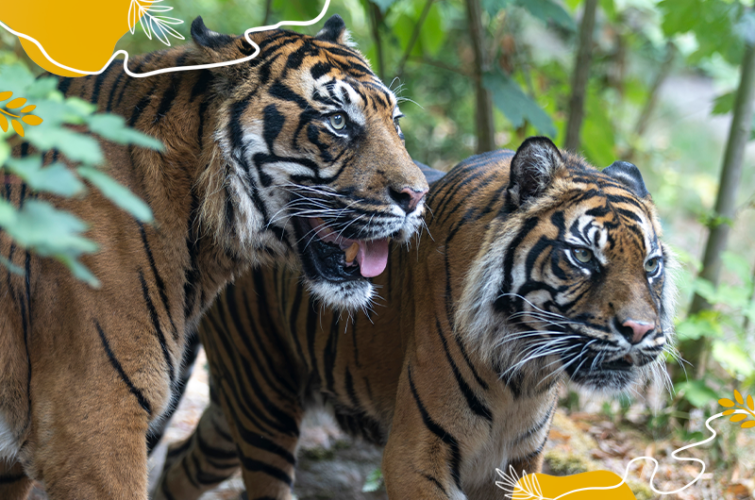
Its dark coat, streaked with black stripes, provides highly effective camouflage. It is also distinguished by its well-developed white whiskers.
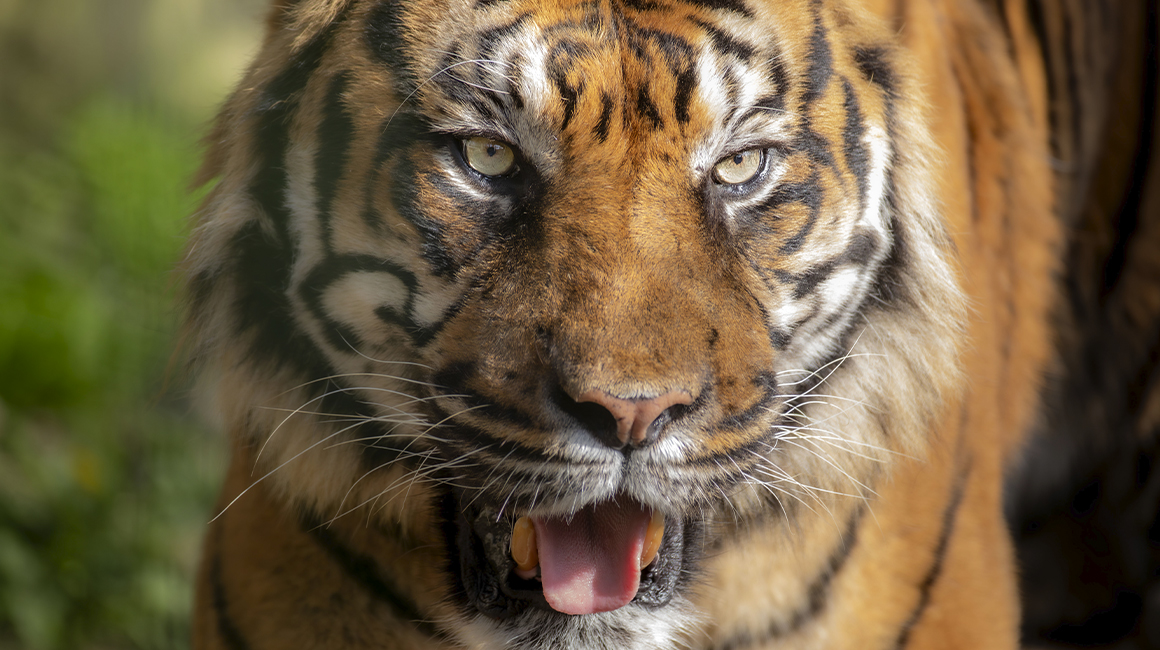
Asu, the male Sumatran tiger distinguished by his well-developed white whiskers
Populations still under severe pressure
Although conservation efforts have led to an increase in certain populations in recent years, the tiger’s situation remains a cause for concern. The species is classified as ‘Endangered’ on the International Union for Conservation of Nature (IUCN) Red List.
Of the nine historically recognised subspecies, three have already become extinct: the Bali, Javan and Caspian tigers. Of the remaining six, three are considered ‘Critically Endangered’: the Sumatran, Malayan and South Chinese tigers, the latter of which is probably extinct in the wild. The Bengal, Siberian and Indochinese tigers, meanwhile, are classified as ‘Endangered’.
Deforestation and habitat fragmentation are among the main threats to the species. In Sumatra, the expansion of agricultural activities, particularly oil palm and acacia plantations, is gradually reducing their habitat and leading to a decline in their prey.
Poaching and the illegal trade also pose a major threat. The tiger’s skin, bones and other body parts are still sought after on certain black markets. Added to this are conflicts with local communities, which can arise when the tigers approach villages or attack livestock.
Situated at the top of the food chain, the tiger nevertheless plays an indispensable role in the balance of its environment. By regulating herbivore populations, it helps to maintain vegetation and ensure the proper functioning of the entire ecosystem. Protecting the tiger therefore means preserving many other species that share its habitat.
Beauval Nature works to support tiger ecosystems
Beauval Nature supports several conservation programmes in Asia, whose activities help to preserve habitats also frequented by tigers. This is particularly the case with the programme dedicated to the pygmy hog, led by the Durrell Wildlife Conservation Trust in the state of Assam, India.
The pygmy hog is a bioindicator species: its presence and population trends provide scientists with information on the condition of the grasslands in which it lives. The programme combines ex situ breeding, reintroduction into the wild, scientific monitoring of individuals and the control of invasive alien plant species.
The preservation of these grasslands benefits a wide variety of species, including Indian rhinos, Asian elephants and tigers. These initiatives serve as a reminder that the conservation of a species necessarily involves the protection of its entire environment.
Tigers to discover and sponsor at Beauval
In the Big Cat Woodloands, Jambi and Asu roam a wooded area, featuring waterholes and various facilities. Both were born in 2008: Asu turned 18 on 27 July 2026, whilst Jambi will celebrate his birthday on 4 August.
Their presence at Beauval helps raise visitors’ awareness of the vulnerability of the Sumatran tiger. It is also part of the EAZA’s ex situ programme dedicated to this particularly endangered island population.
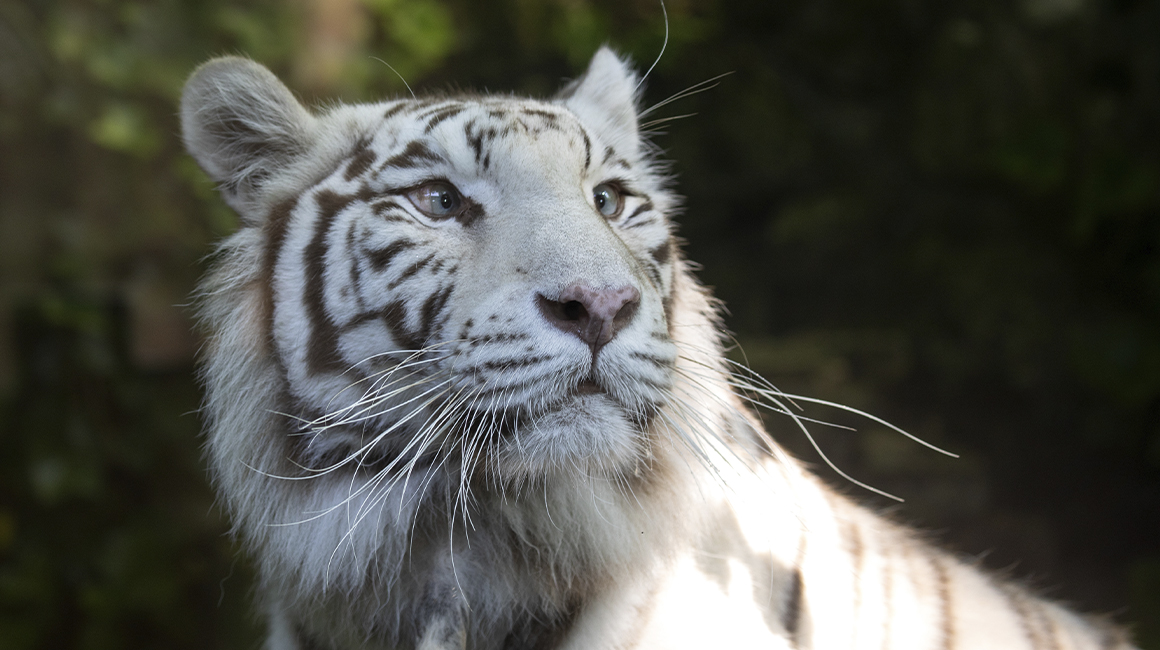
Opposite their enclosure live the white tigers, iconic figures in Beauval’s history. They do not belong to a separate species: their colour is the result of a genetic mutation known as leucism, which causes depigmentation of the coat whilst leaving the stripes visible. Highly visible against the vegetation, these tigers would face great difficulty in ambushing their prey in the wild. In a zoo, they help to raise awareness of tigers and educate visitors about their conservation.
In 1991, the ZooParc de Beauval became the first French zoo to welcome white tigers, with the arrival of Gorby and Raïssa. Today, visitors can see Shiva and Jaipur, as well as their daughter Sushi, who was born at Beauval. Asha, meanwhile, lives in an area not visible to the public. These iconic big cats continue to amaze visitors and convey a message in support of the protection of all tigers.
Would you like to get involved? Sponsor Jambi or Asu! The donations collected, which are tax-deductible, are donated in full to Beauval Nature to support its conservation and research programmes around the world. Several sponsorship packages, each with different benefits, are available to suit all budgets. It’s up to you to choose yours!