A new species of cockatoo discovered thanks to a conservation programme coordinated by Beauval
An exceptional scientific discovery has just been published in the international journal *Conservation Genetics*: a team of researchers has identified a previously unknown genetic lineage, which may represent a new species of microglossus cockatoo.
This study was carried out by a team comprising the National Museum of Natural History, Beauval Nature and the ZooParc de Beauval. The co-authors include Baptiste Mulot (Chief Executive of Beauval Nature) and Laetitia Latorre, Head of Science, Animal Population Management and Conservation at ZooParc de Beauval and European coordinator of the microglossus cockatoo ex situ programme.
The black cockatoo: a parrot unlike any other
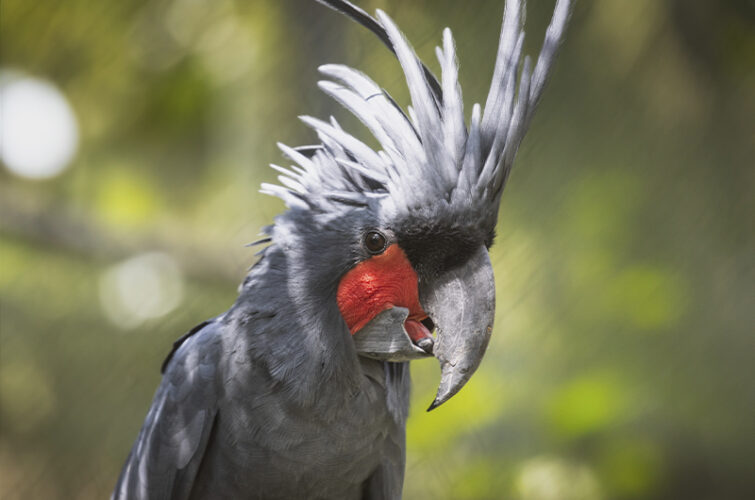
The black cockatoo (Probosciger aterrimus), also known as the microglosse cockatoo, is the largest of the 18 species of cockatoo. Easily recognisable by its entirely black plumage, it also has an impressive beak capable of cracking open palm nuts and other particularly hard seeds.
Native to Papua New Guinea and northern Australia, this bird is also distinguished by its spectacular crest, which can reach up to 15 centimetres. When excited or anxious, it spreads its crest, whilst the bare, red patches on its cheeks become even more vivid.
Another distinctive feature is that, unlike most other cockatoos, males and females look identical, with no visible difference in eye colour or plumage.
Classified as ‘Near Threatened’ by the International Union for Conservation of Nature (IUCN), this species benefits from a European ex situ conservation programme coordinated by ZooParc de Beauval.
Find out more about the species
When genetics reveals hidden secrets
To better understand the genetic diversity of microglossids in European zoos, researchers analysed the DNA of 50 individuals participating in the ex situ programme.
The aim was to determine whether certain birds exhibited significant genetic characteristics that could help improve their management and breeding within the European programme. The results exceeded all expectations.
A new species native to the island of Yapen in Indonesia
The analyses revealed the existence of a genetic lineage entirely distinct from other known sunbirds. This population is believed to originate from the island of Yapen, an Indonesian island off the coast of New Guinea.
The level of genetic difference observed is significant enough to consider this a distinct species in its own right, one that has never been identified before.
This discovery serves as a reminder that even among animals as iconic and well-studied as parrots, biodiversity continues to hold surprises for us.
Is this species already under threat?
However, researchers are concerned about the future of this new species. They have identified nine individuals belonging to this genetic lineage within the ex situ population studied. All nine birds were seized by customs authorities, which highlights the pressure exerted by the illegal trade on this potentially very small population.
This small number suggests that this population may be particularly vulnerable in the wild. Significant culling is reported to have taken place on Yapen Island several decades ago.
Further studies will be needed to accurately assess its conservation status.
The vital role of zoos in research
This discovery illustrates the importance of conservation programmes carried out in modern zoos. Animal populations housed in zoos not only help to preserve threatened species, but also improve scientific understanding of their history and genetic diversity.
This work is the result of a collaboration between the National Museum of Natural History, ZooParc de Beauval and Beauval Nature, carried out as part of the EAZA’s ex situ programme dedicated to microglossids, coordinated by Beauval. Beauval Nature supported this project both scientifically and financially.
This discovery shows that conservation programmes carried out in zoos do not merely serve to protect endangered species: they also help to advance scientific knowledge and, at times, reveal previously unknown biodiversity.
It forms part of the many research projects carried out with the teams at Beauval. Among these, a study published in 2018 demonstrated for the first time in birds the existence of facial expressions associated with positive emotions, showing that blue-and-yellow macaws can blush and raise certain feathers on their heads during interactions with their keepers.
Find out more about the research programmes supported by Beauval Nature on the association’s website.
Come and see the microglosses at Beauval
Did you know? The ZooParc de Beauval is home to eight microgloss parrots – three females and five males. They can be seen in the Allée Historique, where the aviaries were renovated in 2023.
Observing these impressive parrots – now at the heart of a European conservation programme and a major scientific discovery – is a unique opportunity to learn more about a fascinating species and the challenges involved in its conservation.