A red panda cub has been born at Beauval!
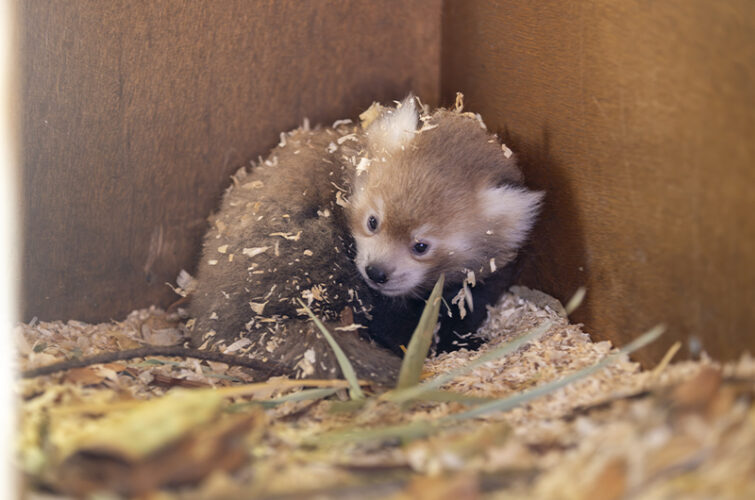
A tiny little face has made its appearance amongst the red pandas at ZooParc de Beauval! Born on 4 July 2026, the cub of Ines and Browny was discovered in the early hours of the morning by the keepers. Still safely tucked away in its den, it is growing peacefully alongside its mum, but visitors may catch a glimpse of it when its mum moves it around.
A birth eagerly awaited by the keepers
For several months, certain changes in Ines’s behaviour had caught the team’s attention. The female was spending more time in the trees, coming down less often to meet the keepers and appearing much more timid than usual. Even the medical training sessions, which she usually takes part in willingly, had become difficult.
These were all signs that had already been observed in her as she approached giving birth!
In the early hours of 4 July, the keepers quickly noticed something unusual: Browny was visible, but Ines remained sheltered inside the muntjac house. She didn’t leave the premises, contrary to her usual habits. Upon closer observation, the team discovered the newborn nestled close to her.
Ines, an experienced and attentive mum
Ines looks after her baby with great care. This experienced mother chooses the shelter where she wants to settle the baby herself and may move it if she feels another spot will be quieter. An unusual noise, for example, might prompt her to move to another den to protect her baby.
The father, Browny, does not take part in raising the cub. This behaviour is entirely natural for the red panda, a predominantly solitary species. In the wild, males and females mainly come together during the mating season. Interactions between Browny and his cub may become slightly more frequent once the cub has grown and starts venturing outside.
A cub that’s still very shy
For the moment, the cub isn’t walking yet. Its movements are limited to a few tumbles around its den! Its eyes are now wide open and it reacts to the sounds around it.
Its sex is not yet known. Sex determination and the fitting of its identification microchip will take place when it is around 3 or 4 months old. As the first few weeks are particularly important for its development, the teams are prioritising ensuring peace and quiet for Ines and her cub.
Over the coming months, the baby will put on weight and its fur will thicken. The white markings on its face will also become more pronounced. At around 3 or 4 months, it should start to vocalise more and display more alert, even defensive, behaviour.
Every effort has been made to keep him cool
The hot weather presents a daily challenge for the teams. Several improvements have therefore been made to maintain as comfortable a temperature as possible inside the building, ideally between 23 and 26°C.
In particular, an air-conditioning system has been installed to cool and ventilate the space. Outside, sprinklers and misting systems also help to keep the area cool. The keepers’ aim is to offer Ines a range of options so that she can choose the spot that suits her best, without them ever having to move the baby themselves.
These changes might have taken some time for her to adjust to. However, Ines has continued to use the hut and has brought her baby there.
“This proves that she trusts us. It’s lovely to see that these changes haven’t upset her,” says Fabien, an animal keeper.
When will we be able to catch a glimpse of the baby?
We’ll need to be patient a little longer… The baby is currently well hidden in its den, but a few particularly lucky visitors might already catch a glimpse of it when its mum moves it around.
Within the next one to two months, Ines should start carrying her baby around more regularly. There should then be more opportunities to observe it.
The cub does not yet have a name. This will be chosen later, once its sex has been determined.
Three red pandas now live at Beauval
The group currently consists of:
- Browny, a male born on 20 June 2017 at Beekse Bergen Safari Park in the Netherlands,
- Ines, a female born on 12 June 2017 at Rotterdam Zoo, in the Netherlands,
- their baby, born on 4 July 2026 at Beauval.
An encouraging birth for an endangered species
The red panda is classified as ‘Endangered’ on the IUCN Red List, the International Union for Conservation of Nature. In the wild, the species is particularly affected by habitat degradation and fragmentation, linked to the expansion of agriculture, deforestation and forest fires.
Against this backdrop, every birth in a zoo is of particular importance. It contributes to the collective efforts to ensure the long-term survival of this fascinating species and to raise public awareness of the threats it faces.
Become a sponsor to support the protection of endangered animals
Would you like to take concrete action to help endangered species? You can sponsor Ines, our female red panda, and thereby contribute to the conservation programmes supported by the Beauval Nature association around the world.
In Nepal, Beauval Nature supports, in particular, a programme run by the Red Panda Network to protect red pandas and their forests. Monitoring populations, combating poaching, restoring their habitat and raising awareness amongst local communities: the actions carried out on the ground contribute directly to the preservation of the species.
From €20, there are several options allowing you to become a ‘friend’, ‘supporter’ or ‘champion’ of biodiversity. You’ll receive exclusive rewards and can claim a tax relief of up to 66 per cent of your donation amount.