A focus on ethology, the science of animal behaviour
At the heart of ZooParc’s remit lie the conservation of endangered species, public education, scientific research and… animal welfare. Just like our other missions, animal welfare is a daily priority and receives constant attention, based on the latest scientific knowledge and careful observation of our residents.
In order to improve scientific understanding of the animals housed at ZooParc de Beauval and to contribute to the continuous improvement of their welfare, ZooParc de Beauval and Beauval Nature carry out several collaborative research projects each year. These studies, funded by Beauval Nature and carried out at the ZooParc de Beauval, are entrusted to ethology students. It was within this framework that the ethology interns, Maude and Laura, carried out their research over a six-month period, before presenting their findings to the animal care team and other ZooParc staff at the beginning of July.
Ethology… what is it?
In practical terms, ethology refers to the scientific study of animal behaviour. It can be carried out in their natural habitats, but also in laboratories, sanctuaries or zoos, such as Beauval.
The methodology is generally based on the same principle: drawing on various observations, the ethologist can develop ethograms, which catalogue all the animals’ behaviours, in order to quantify and analyse them.
In zoos, this science is crucial: it enables us to better understand the animals and their biology, and thus to protect them more effectively.
Several ethological studies are carried out each year at Beauval: in 2025, there were six such studies, which addressed topics as varied as reproductive success in cranes, cohesion within a pack of Arctic wolves, and spinal degeneration in primates, amongst others.
In 2026, two topics were selected: maternal care in large herbivores and the social dynamics of two groups of gorillas.
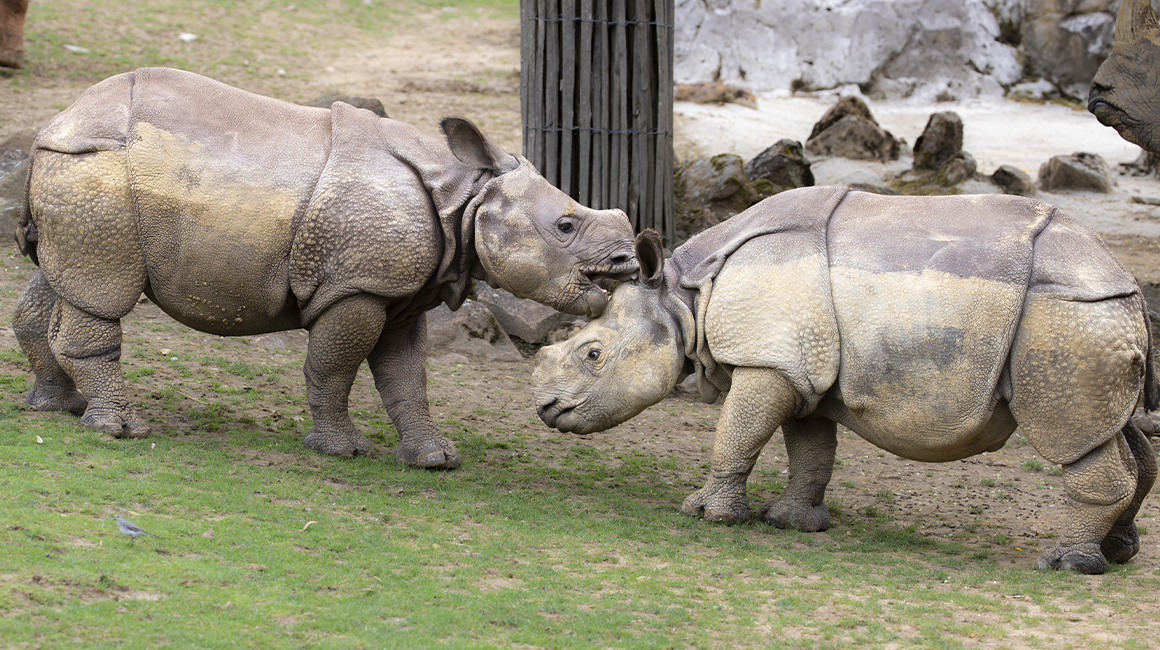
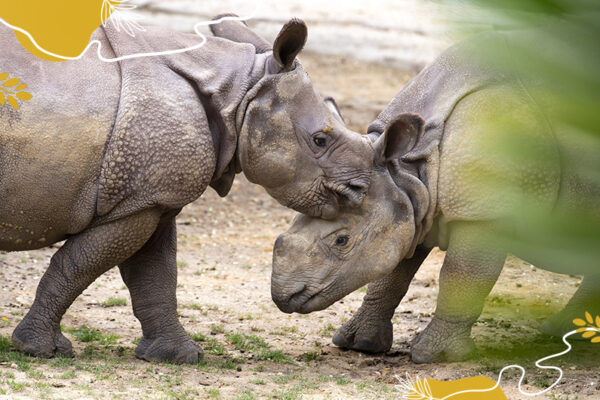
Bahïs and Neytiri playing together
Research topic no. 1: maternal care in large herbivores
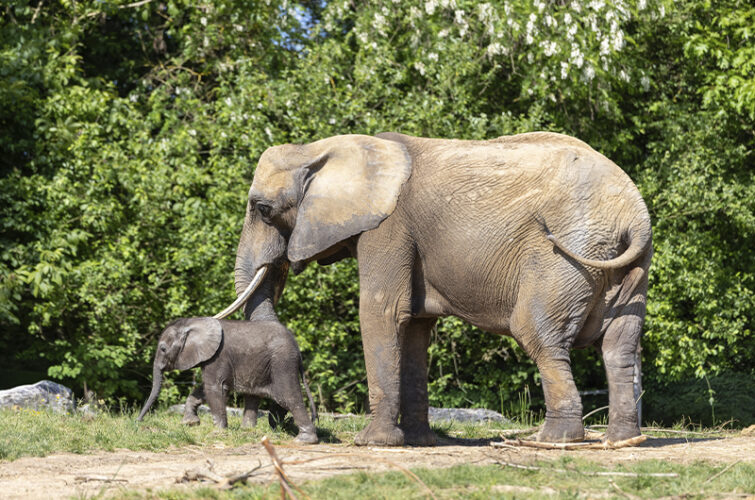
Maude Fouquet, a Master’s student in Applied Ethology at Sorbonne Paris Nord University, was able to put her knowledge to good use during a six-month placement at ZooParc de Beauval. Her research topic? Maternal and filial behaviours (notably milk consumption), as well as bonding and resting patterns in two different species of herbivores: the Indian rhinoceros and the African savannah elephant.
For over three months, she was able to observe the growth of Bahïs and Neytiri, the two baby Indian rhinos born on 14 September 2025 and 1 January 2026, and the first steps of the two elephant calves, Himba and Rosie, born on 15 February and 22 March 2026.
Her research focused on a very specific area:
- The number of breastfeeding-facilitating postures, that is to say, the positions adopted by the mother to enable her calf to suckle more easily;
- The number of protective postures, when the mother adopts a position intended to protect her calf;
- Motor aids, in other words the movements by which the mother supports or facilitates her young’s movements;
- The frequency of contact between the mother and her baby;
- The number and duration of feeds, in order to monitor the progress of breastfeeding over time;
- The number and duration of rest periods, to better understand the recovery periods and habits of the mother and her young, as well as how these change over time as the young grow older.
Maude’s conclusions are clear: as the calves grow, the frequency of maternal care and feedings decreases, whilst the distance separating them from their mother increases. This is a perfectly natural development that begins well before weaning.
Indeed, at the end of the study, Bahïs, the oldest of the four calves observed, was just over seven months old. Yet, in Indian rhinos, weaning generally does not occur until between 3 and 4 years of age. In the African savannah elephant, weaning occurs even later, taking place on average around the age of 8 years.
Maude’s observations also highlighted a difference between these two species in the way the young gradually gain independence. In the Indian rhinoceros, a solitary species, the calf stays very close to its mother, who is its sole point of reference. In contrast, African savannah elephants live in matriarchal herds: the young therefore grow up in the company of several females, who also play a part in their learning and protection.
Relive Himba and Rosie’s release
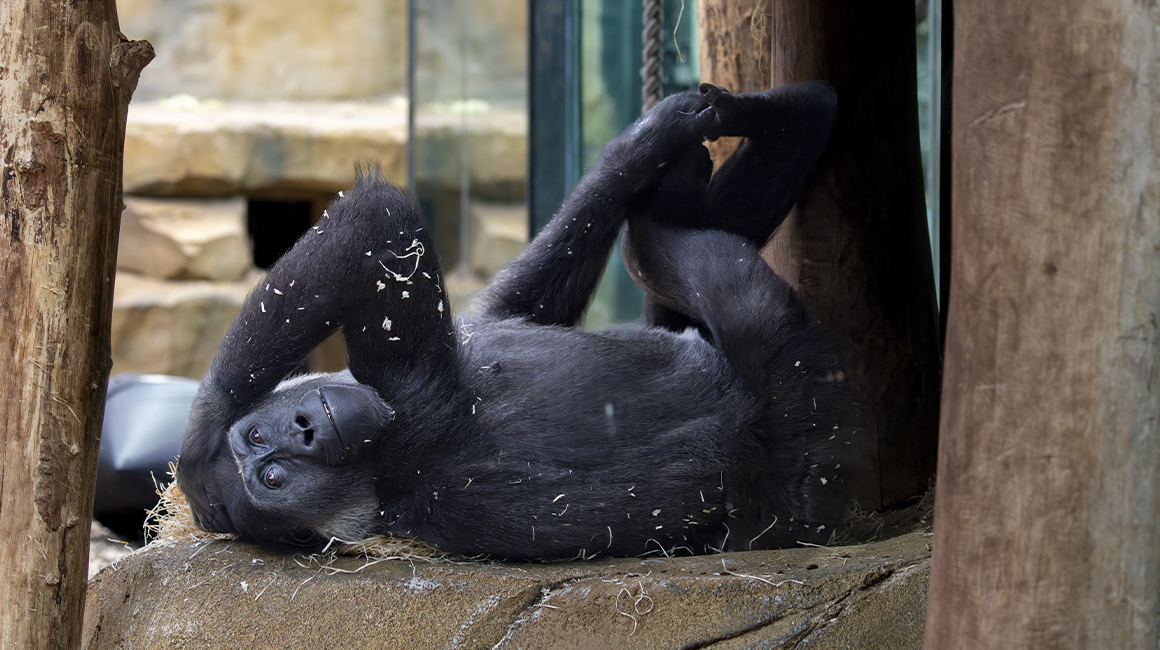
Anandi has settled in well with the group
Research topic no. 2: the social dynamics of two gorilla groups following a change in their composition
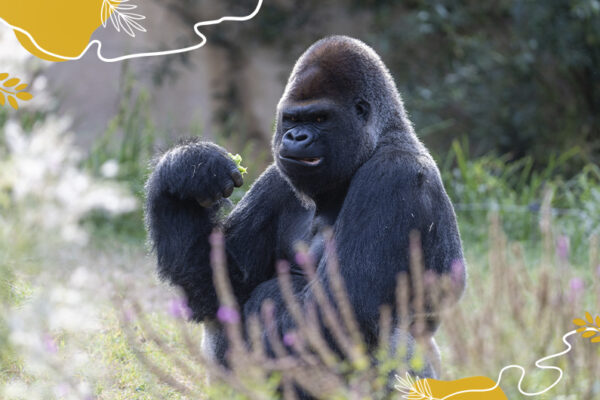
The other ethology research topic for 2026 was led by Laura Swynghedauw, also a Master’s student in Applied Ethology at Sorbonne Paris Nord University. During her observation period, she was able to alternate between the two gorilla groups at the ZooParc:
- the harem, which lives in the Gorilla Greenhouse and comprises the dominant male Euro, along with the females Kabinda, Sheila, Sawa and Anandi;
- the group of single males, visible near the chimpanzee island, comprising Asato, the former dominant male, and his sons Mapenzi, Yamba, Kiwano, M’Baku and Kovanga.
These two groups were formed recently. It was in mid-November that Asato and his sons left the group of females, who were joined by Euro a few days later. Then, in January, the female Anandi joined this new group.
This research had one key objective: to analyse the social relationships within these newly formed groups, as these provide a valuable indicator for assessing the well-being of the individuals. To this end, Laura focused on the various interactions between the gorillas, which ethologists generally classify into three main categories:
- Affiliative interactions, which involve behaviours that foster social bonds, such as physical contact, play or individuals drawing closer to one another.
- Agonistic interactions, which involve situations of conflict, threat or avoidance and help to establish the hierarchy within the group.
- Dominance interactions, which also help to establish or reaffirm the hierarchy within the group, without necessarily leading to a confrontation.
Laura’s findings are also encouraging. Within the harem, they reveal that there is no source of ongoing conflict between individuals and that dominance interactions have tended to decrease over time. This indicator thus shows that relationships between individuals are well established and that Anandi has integrated well into the group, particularly with the other young female, Sawa, with whom she interacts frequently.
As for the group of single males, relationships between individuals continue to evolve, as Asato’s sons are still young and their place in the hierarchy may yet change. For the time being, Asato continues to maintain his dominance over the group and manage conflicts, his status remaining unchallenged by his sons.