World Turtle Day: who’s hiding under those beautiful shells?
Today is World Turtle Day… An unmissable annual event established in 2000 by the American Tortoise Rescue organisation and now celebrated in 190 countries around the world.
To mark the occasion, we invite you to discover these fascinating animals, many of which you can see at ZooParc de Beauval: whether aquatic or terrestrial, small or imposing, carnivorous or herbivorous, they all have wonderful surprises in store for us beneath their shells!
I’m coming to see the tortoises
300 species of tortoises across the world
A shell, a clumsy gait, an ancient appearance: turtles are particularly distinctive. Having been on our planet for over 230 million years, even before the dinosaurs existed, they bear witness to the evolution of biodiversity. Today, there are over 300 different species and, here at Beauval, we are lucky enough to be able to show you nearly twenty of them. It’s time to introduce them to you!
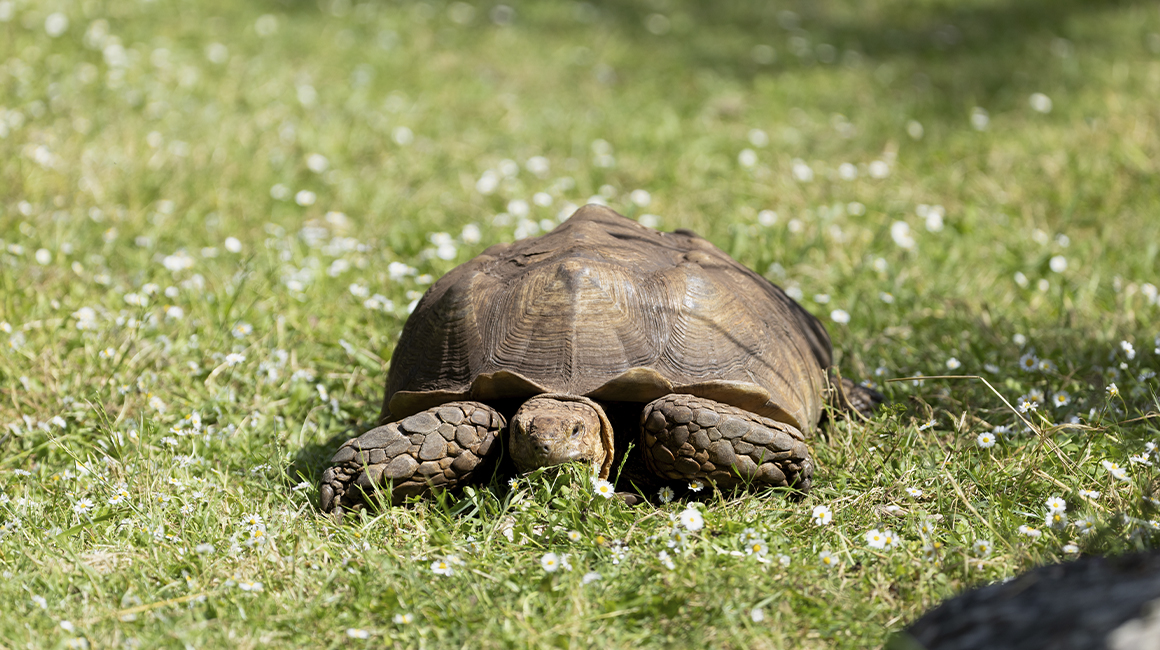
The African spurred tortoise is Africa’s largest land tortoise
An overview of Beauval’s tortoises and their characteristics
- The marginated tortoise (Testudo marginata), the largest species of European tortoise, can be seen in the outdoor aviaries of the Chimpanzee and Orangutan House, alongside the white-cheeked tamarins and golden lion tamarins.
- The leopard tortoise (Stigmochelys pardalis) owes its name to the spots on its shell. To see it, head to the Elephant House: there it lives alongside…
- … the pancake tortoise (Malacochersus tornieri), which takes its name from its completely flat shell! However, the shell is actually quite domed at birth: it flattens out as the tortoise grows.
- The spider tortoise (Pyxis arachnoides) spends most of its time hidden under stones and roots, sometimes remaining motionless for months on end. At Beauval, you can spot it in the Land of the Lions tunnel.
- The Cayenne podocnemis (Podocnemis unifilis) and the Saint-Hilaire tortoise (Phrynops hilarii) are two freshwater turtles you can discover in the Gorilla Greenhouse pond.
- The African spurred tortoise (Centrochelys sulcata) is Africa’s largest land tortoise: the record for this species is held by a male measuring 84.5 cm and weighing 120 kg. During your visit, you can see it near the African Savannah.
Also, whilst visiting the vivarium (no. 37 on the visitor map), you can discover:
- The ornate forest tortoise (Rhinoclemmys pulcherrima), which is one of the most colourful of them all! Its colours are reminiscent of those of the highly venomous coral snake, which may deter predators.
- The red-footed tortoise (Chelonoidis carbonarius), which is distinguished by its unusual gait: its very long legs allow it to move in long strides, with its limbs held upright. This method allows it to cross muddy areas or small backwaters with ease.
And during your expedition to the Equatorial Dome, you will encounter:
- The giant podocnemis (Podocnemis expansa), which spends most of its time in the water, searching for food. It is the largest freshwater turtle in the Americas: the females, which are larger than the males, can weigh up to 90 kilos!
- The Malaysian giant tortoise (Orlitia borneensis) and the pig-nosed turtle (Carettochelys insculpta), which inhabit the territory of the false gharials. While the former is unique in its ability to dive to great depths, the latter is no less remarkable: it is the only turtle in the world to possess a prominent snout… hence its name!
- The giant heosemys (Heosemys grandis), which, like many species of Asian freshwater turtles, is considered sacred. Unfortunately, this belief has led to it being captured en masse to be kept in Buddhist temples
- Bourret’s box turtle (Cuora bourreti), which has the astonishing ability to close its shell completely to protect itself from predators, thanks to the articulation of its plastron.
- The matamata turtle (Chelus fimbriata), which resembles a pile of plant debris… This unusual appearance allows it to blend into its surroundings, an ideal technique for hunting the small fish, amphibians and aquatic invertebrates on which it feeds.
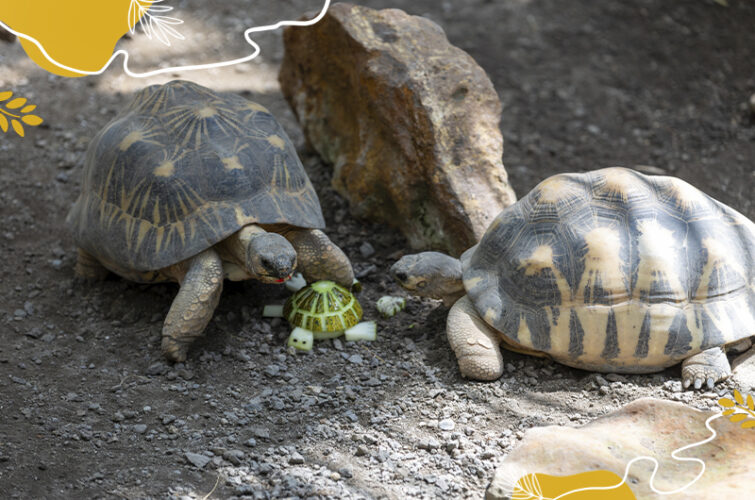
- The Madagascar star tortoise (Astrochelys radiata), which has a very long life expectancy. The oldest of all tortoises of this species was born in 1777 and died in 1965… at the age of 188!
- The yellow-footed box turtle (Chelonoidis denticulata) and the royal box turtle (Batagur affinis), which are found in the territory of Schneider’s caimans. These two species are rather complementary: the former is mainly terrestrial but is also capable of swimming, whilst the latter swims very well but is not very comfortable on land.
- The Aldabra giant tortoise (Aldabrachelys gigantea), undoubtedly the most unmissable of all the tortoises at Beauval. It is currently the largest land tortoise on Earth and, interestingly, it has the unique ability to drink through its nostrils, with its head held vertically above the water!
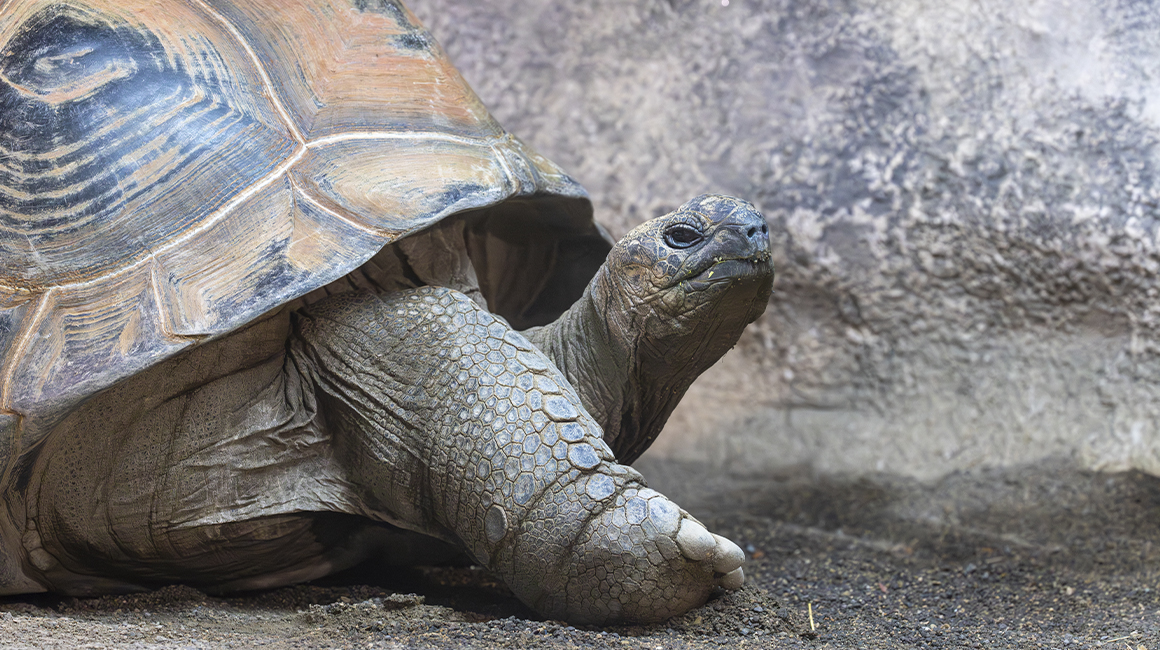
You can sponsor Lack, the largest of all the tortoises at ZooParc
Witnesses to evolution… in need of protection!
Although tortoises are fascinating animals that seem to have survived every era, they are nonetheless under threat. Habitat destruction, hunting and poaching, as well as climate change and pollution, are the main factors reducing turtle populations worldwide.
As well as working to protect them by showcasing these fascinating animals and helping with their breeding, ZooParc de Beauval is also committed to conservation through its association, Beauval Nature. Indeed, by supporting the HELP Congo association, it contributes to the preservation of biodiversity in Conkouati-Douli National Park. Known for its populations of chimpanzees, elephants, gorillas and manatees, this park is also the world’s second-largest nesting site for leatherback turtles, the largest of all turtle species. The Clean and Protected Beaches project led by HELP Congo aims to help clean the park’s beaches by raising public awareness and organising waste collection and sorting operations, thereby promoting the reproduction and growth of the species’ populations.
And if you too would like to help protect turtles, you can choose to sponsor Lack, the largest of all the turtles at ZooParc. Through this sponsorship, numerous conservation and research programmes will be supported, including HELP Congo. This is an opportunity for us to take a giant step forward together in preserving biodiversity!