World Chimpanzee Day: so fascinating, yet so threatened
On 14 July 1960, in Tanzania, Jane Goodall, the renowned British primatologist to whom we paid tribute in October 2025, set foot for the first time on what would later become Gombe Stream National Park. It was there that she devoted her life to chimpanzees: discovery after discovery, she revolutionised science and left a considerable legacy.
Now, every 14 July, World Chimpanzee Day pays tribute to these fascinating primates, whilst raising awareness of their extraordinary characteristics and the many threats they face.
I’m coming to see the chimpanzees
The chimpanzee: an extraordinary primate
There is more than one reason why chimpanzees have captivated Jane Goodall, as well as many researchers, carers and visitors. These animals inspire fascination and curiosity, and leave no one indifferent.
They are among the animals closest to us: 98.4 per cent of human and chimpanzee DNA sequences are, in fact, identical. They also display great intelligence and an excellent memory, which has even enabled some individuals to learn sign language!
Chimpanzees are capable of planning ahead and can also use tools: for example, they use twigs or sticks to catch insects, and leaves as napkins or as spoons to drink water. To crack open hard nuts, they may also use large stones: in total, 65 different tools have already been recorded!
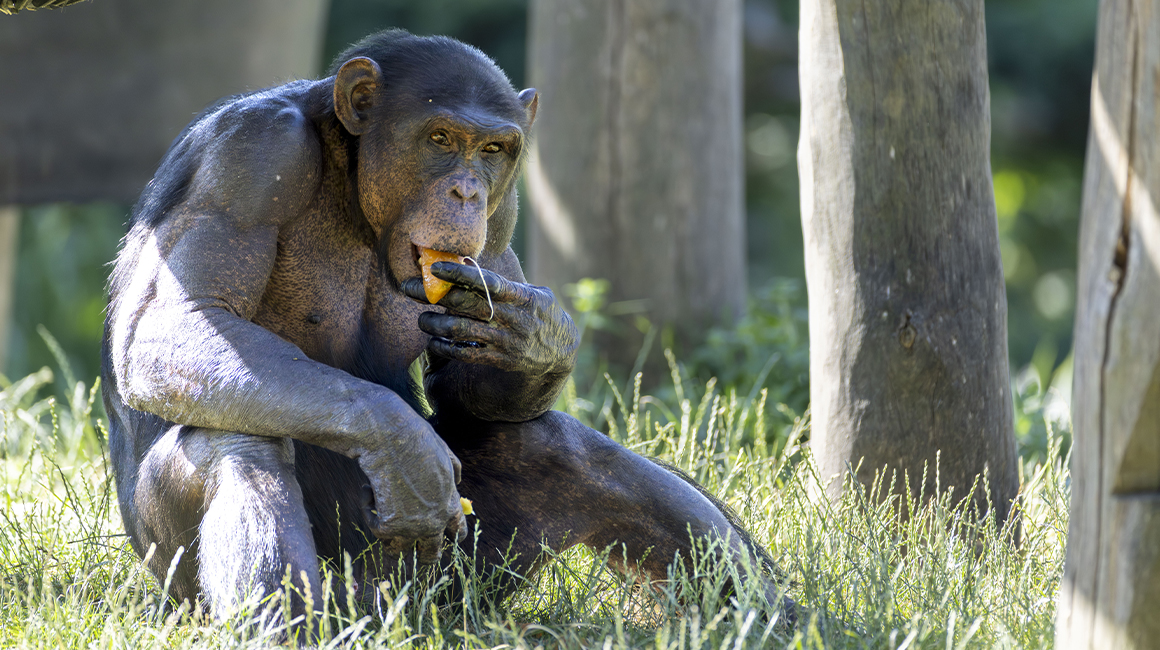
On the menu: 5 kg of fruit and vegetables a day
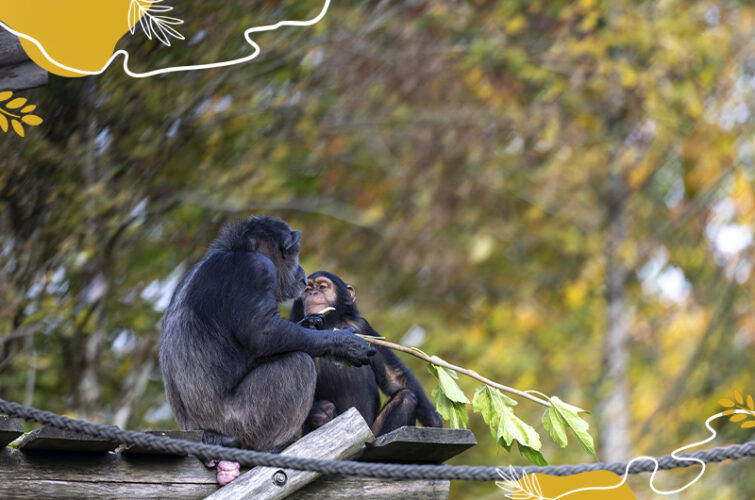
Furthermore, within chimpanzee communities, relationships are as complex as they are fascinating. These relationships can take various forms: friendly, sexual, hostile or neutral. For example, very strong bonds unite brothers and sisters, just as they do between mothers and their young. But the strongest relationships seem to be those between adult males: they spend a great deal of time together, particularly grooming one another, which they do more frequently amongst themselves than the females do. These good relationships are indeed essential, as it is the males who patrol the territory’s borders together.
As well as helping to remove ticks, dirt and dead skin from the fur, grooming is essential for establishing and maintaining social bonds between individuals. The same is true of play, which is important for chimpanzees of all ages, although it is more noticeable among younger individuals. Through play, they develop social and even friendly relationships that can last a lifetime.
Find out more about chimpanzees
A species at the mercy of humans
Unfortunately, like many other animal species, chimpanzees are facing the expansion of human activities that threaten their survival.
Today, various factors are putting their populations at risk:
- Poaching, which fuels a thriving illegal trade. Adult chimpanzees are often killed for their meat, leaving behind many orphans, who are usually captured to be sold as pets.
- Deforestation, caused by mining, agriculture and logging.
- The transmission of diseases, such as tuberculosis, pneumonia and Ebola, which is directly linked to the close proximity between chimpanzees and humans and exacerbated by population growth and deforestation.
Let’s work together to protect chimpanzees
To help chimpanzees, everyone can take action in their own way.
By choosing products from sustainably managed forests (FSC or PEFC certified), you are helping to limit deforestation and the fragmentation of chimpanzees’ habitats. Similarly, you can help stop the trade and poaching by avoiding the purchase of products derived from these animals, and by refraining from sharing or engaging with social media content featuring chimpanzees kept as pets.
And if you’d like to go a step further, you can also support Beauval Nature, which funds HELP Congo, amongst other organisations. Based in the heart of Conkouati-Douli National Park, this organisation protects and cares for a population of 24 injured or orphaned chimpanzees, victims of poaching or the illegal trade. Spread across three large islands, where they live in semi-freedom, they each receive 5 kg of fruit and vegetables a day. However, these animals are fed and monitored without direct contact, to protect their health!
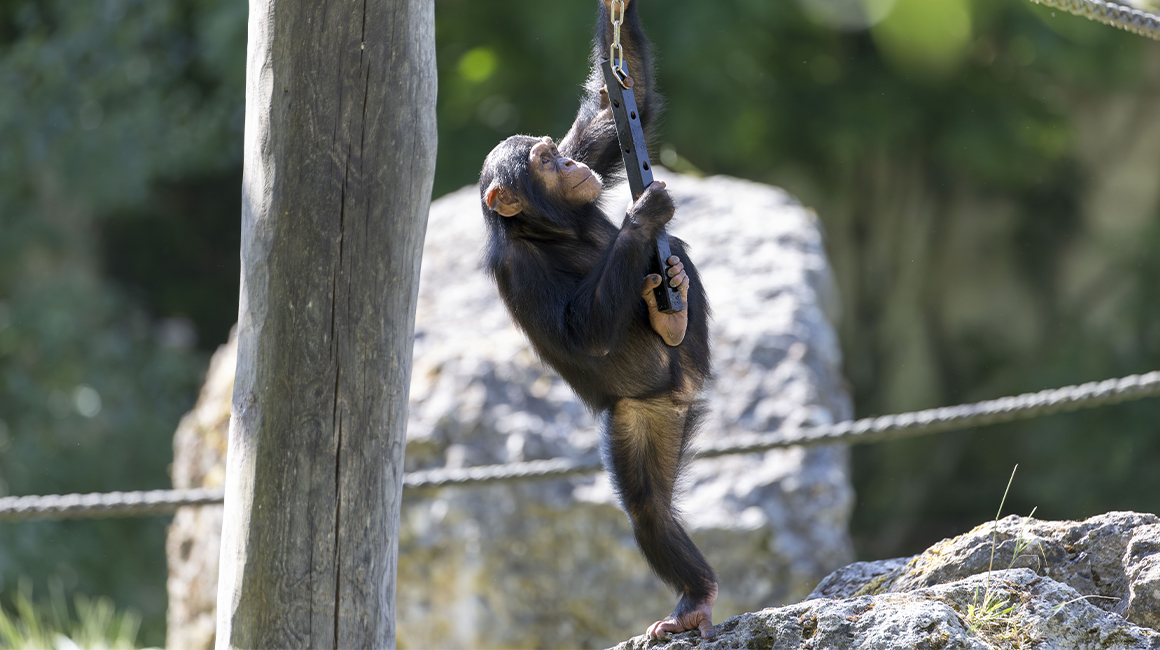
N’Saka, the youngest of the Beauval chimpanzees
The organisation’s other mission is to study local biodiversity – from elephants to gorillas, including manatees and leopards – in order to better protect them. It also carries out various research projects on wild chimpanzee communities to better understand their distribution, structure and dynamics: by 2025, five distinct communities had been identified within the research area, comprising around 300 individuals. This research also enables the organisation to monitor the chimpanzees it has released into the wild.
The chimpanzees at Beauval
During your visit to the ZooParc, you can meet our group of 14 chimpanzees, who live in the Chimpanzee and Orangutan House. Whilst they all have their own distinct personalities, N’Saka stands out for his boundless energy and playful nature: born at Beauval on 21 May 2021, he is in fact the youngest of the group!
You can also sponsor his older brother, Tumba. Known for his sensitive and unifying personality, he was also born at Beauval on 14 January 2009.
By choosing to sponsor him, you’ll be playing your part in the conservation of endangered species. In return for a donation to Beauval Nature – 66 per cent of which is tax-deductible – you’ll receive a range of benefits: updates from the organisation, an invitation to the annual Sponsors’ Day, an admission ticket or a ZooPass… and even a special meeting with your sponsored animal.