An okapi calf has been born at Beauval: Quinta and Mambasa are first-time parents!
– Update 7 September 2026 –
The okapi calf now has a name: Mwindo!
Quinta and Mambasa’s baby is called Mwindo! His name, which means ‘eclipse’ in Lingala – a language spoken in the Democratic Republic of the Congo, amongst other places – was chosen by the keepers following a vote. It’s a lovely nod to the solar eclipse on 12 August, which took place the day before he was born.
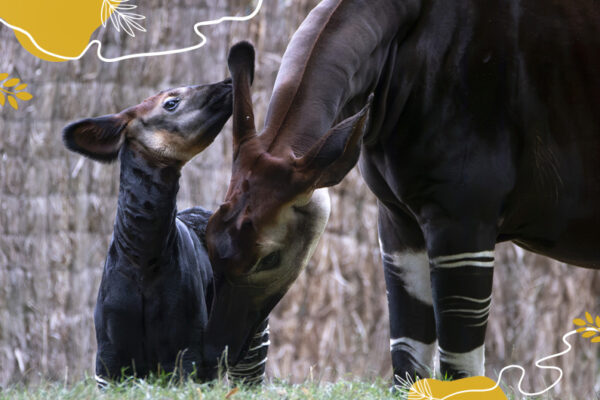
Mwindo is also continuing to thrive. Curious, shy and still a little timid, he regularly ventures out onto the plain during the day and likes to hide in the bamboo. The keepers are now almost certain that he is a young male: they have observed an anatomical bulge beneath his belly, characteristic of males. However, we will have to wait for confirmation from the vets to be 100 per cent sure.
————————————————–
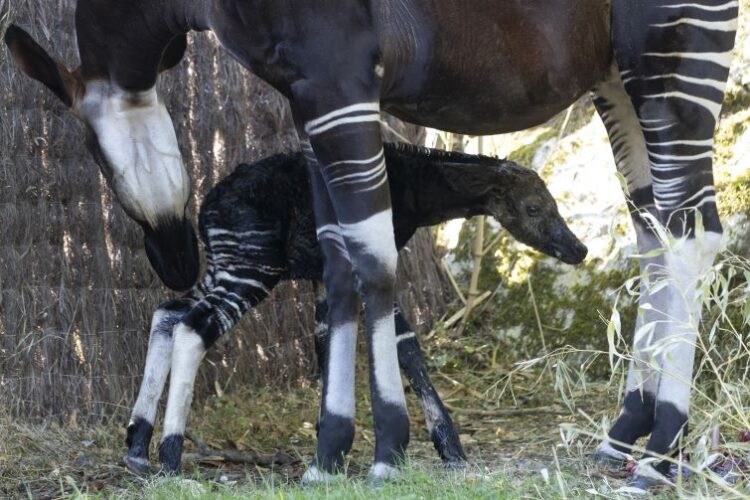
The female, Quinta, and the male, Mambasa, have become parents for the first time. On Thursday 13 August, at precisely 9.09 am, the female gave birth to her baby on the okapi plain, watched by several visitors. Mambasa, the father, was himself born at Beauval in 2018: a new generation is thus coming of age at the ZooParc de Beauval. On its feet some thirty minutes after its birth, the newborn quickly found its mother’s teats.
This third okapi birth at Beauval brings the group’s total to five.
A swift okapi birth witnessed by visitors
The first signs that the birth was imminent appeared shortly before 9 am. Quinta was outside at the time, accompanied by Thamani, the other young female in the group. A keeper on site immediately monitored the situation to ensure that everything was proceeding normally.
A few minutes later, the calf was born and was already beginning to move. The birth took place naturally, without any intervention from the animal care or veterinary teams. Several visitors standing in front of the enclosure were thus lucky enough to witness this particularly rare event.
Thamani approached the newborn to sniff it. Whilst this first encounter went smoothly, the keepers then decided to separate her from Quinta so that the young mother and her calf could enjoy their first moments together in peace.
Quinta, a first-time mother
No sooner had the calf been born than it quickly showed its vitality. At around 9.45 am, less than an hour after its birth, it was already standing on its long legs. Quinta immediately licked and stimulated it, before guiding it towards her teats. The first feed was observed an hour after birth.
Although a first-time mother, Quinta was discovering her role as a mother. From the very first minutes, she was calm and attentive towards her cub. “She looked after him very well straight after the birth. She licked him and guided him to her teats,” says Madison, an animal keeper in the Asian Plains section for nearly eight years.
The newborn was not handled or weighed. As he is standing up, moving around and suckling properly, the teams are currently opting for remote monitoring to allow the mother and her baby to develop at their own pace.
For Madison, who first met Mambasa when he was just a few months old himself, this day will remain particularly memorable: “We’re incredibly proud and delighted that this baby is doing well. It’s wonderful to see. An okapi birth is an experience you don’t come across every day in a keeper’s life.”
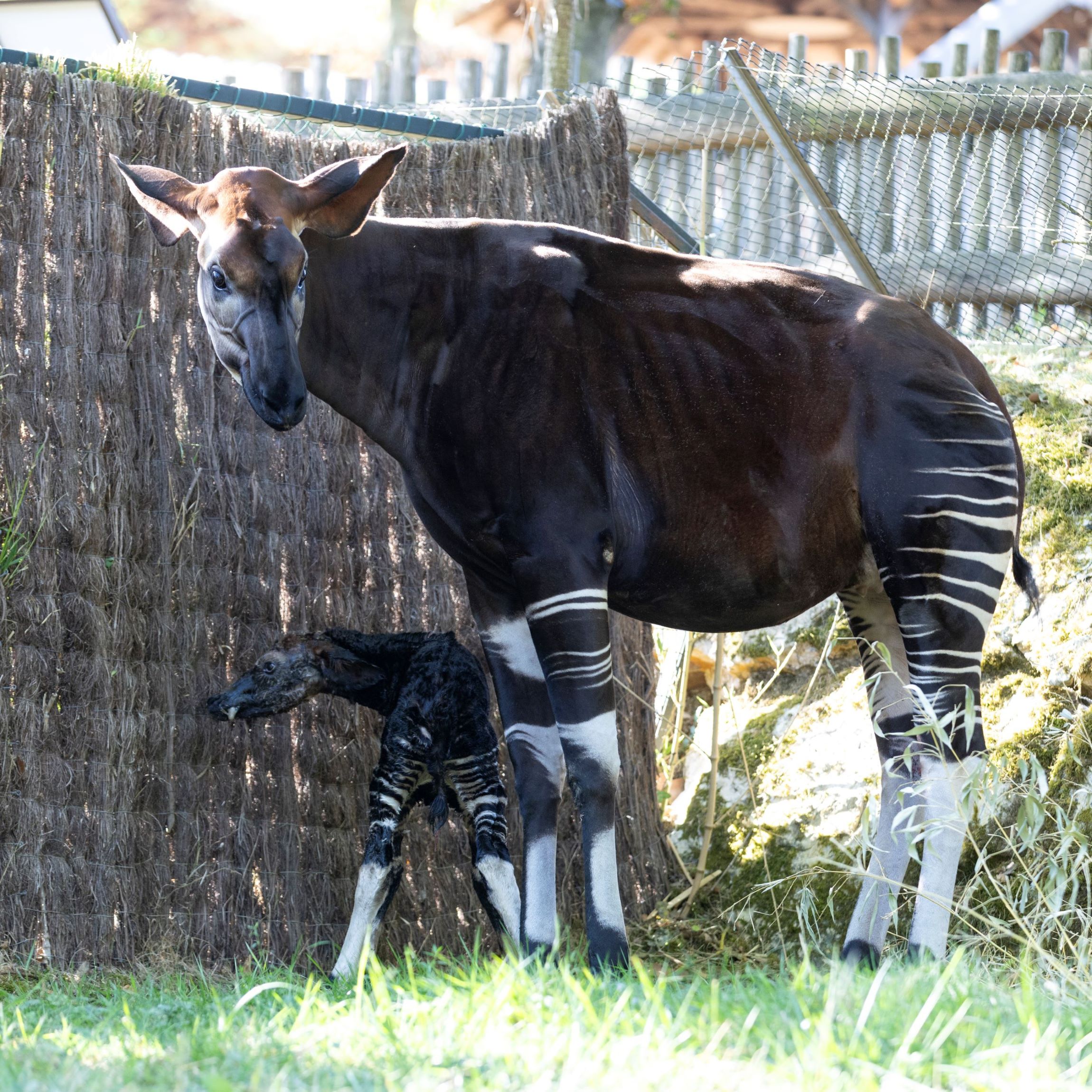
Quinta and her baby
The okapi’s pregnancy closely monitored by the teams at Beauval
Quinta and Mambasa were last observed mating in May 2025. A few months later, from September onwards, the teams were able to confirm the pregnancy thanks to weekly hormone tests carried out on samples of Quinta’s faeces.
The calf was originally expected in September. It therefore made its first appearance a little earlier than anticipated, whilst still falling within the species’ usual gestation period.
In okapis, gestation lasts between 14 and 16 months. The female usually gives birth to a single calf, weighing around 20 kilos. Like Quinta’s calf, the newborn is generally able to stand up about thirty minutes after birth and suckle within the following hour.
Although it is already able to move about, a young okapi behaves very discreetly during its first few weeks. In its natural habitat, it usually remains hidden in the vegetation, whilst its mother returns regularly to nurse it. This strategy minimises the risk of attracting the attention of predators.
The calf will begin to try eating plants at around three weeks old. Weaning takes place between six months and a year, but it will not reach its adult size until it is around three years old.
Find out more about the species
A third okapi birth at Beauval and a fifth individual in the current group
Until this birth, the ZooParc de Beauval was home to four okapis: the males Bösi and Mambasa, and the females Quinta and Thamani. The oldest member of the group, Bösi, was born in 2007 at Berlin Zoo (Germany). Mambasa, meanwhile, was born at Beauval in 2018. Quinta was born at Basel Zoo (Switzerland) in 2019 and joined Beauval in 2021, whilst Thamani, born at Wilhelma Zoo in Stuttgart (Germany) in 2022, arrived at the ZooParc de Beauval the following year. With the arrival of the newborn, the group now numbers five individuals.
This is the third okapi birth recorded at Beauval. The first, that of M’Buti, took place on 27 June 2013. This female, who moved to Rotterdam Zoo in 2015, was the first okapi calf born at ZooParc since the species arrived in 2005.
Then, on 4 August 2018, Mambasa was born. Still living at Beauval, he has grown up under the watchful eyes of the ZooParc de Beauval staff and visitors.
A new generation is now coming of age at Beauval, as Mambasa – himself born at the ZooParc de Beauval – is now becoming a father.
When will we be able to see the baby okapi?
Over the next few days, the keepers will closely monitor the calf’s milk intake, digestion and behaviour, whilst ensuring that Quinta continues to look after it properly. This monitoring will be carried out regularly throughout the day, without disturbing the mother and her newborn.
The teams will decide, based on their behaviour and weather conditions, whether they can remain on the open plain or whether it would be better to move them indoors. In either case, visitors will be able to see the calf, either outside or through the windows of the okapi house.
However, visitors may need to be patient at times: like all young okapis, it may spend long periods lying down, out of sight.
The okapis can be seen at the ZooParc de Beauval near the elephant plains. They live harmoniously alongside the yellow-backed duikers, a species that has been at Beauval since 2022 and is on display at just one zoo in France.
Quinta, the mother of the baby okapi, is available for sponsorship
Among the females in the group, Quinta is also one of the ambassadors for her species to the public. Born on 30 October 2019 at Basel Zoo in Switzerland, she arrived at Beauval in April 2021. Visitors can sponsor her by choosing one of the various sponsorship packages on offer, starting from €20 for a one-year period.
Sponsoring Quinta means making a donation to Beauval Nature and helping to fund biodiversity conservation programmes. Depending on the package chosen, sponsors receive various rewards, such as a photo and a sponsorship certificate, news from Beauval Nature, and even the chance to meet the sponsored animal.
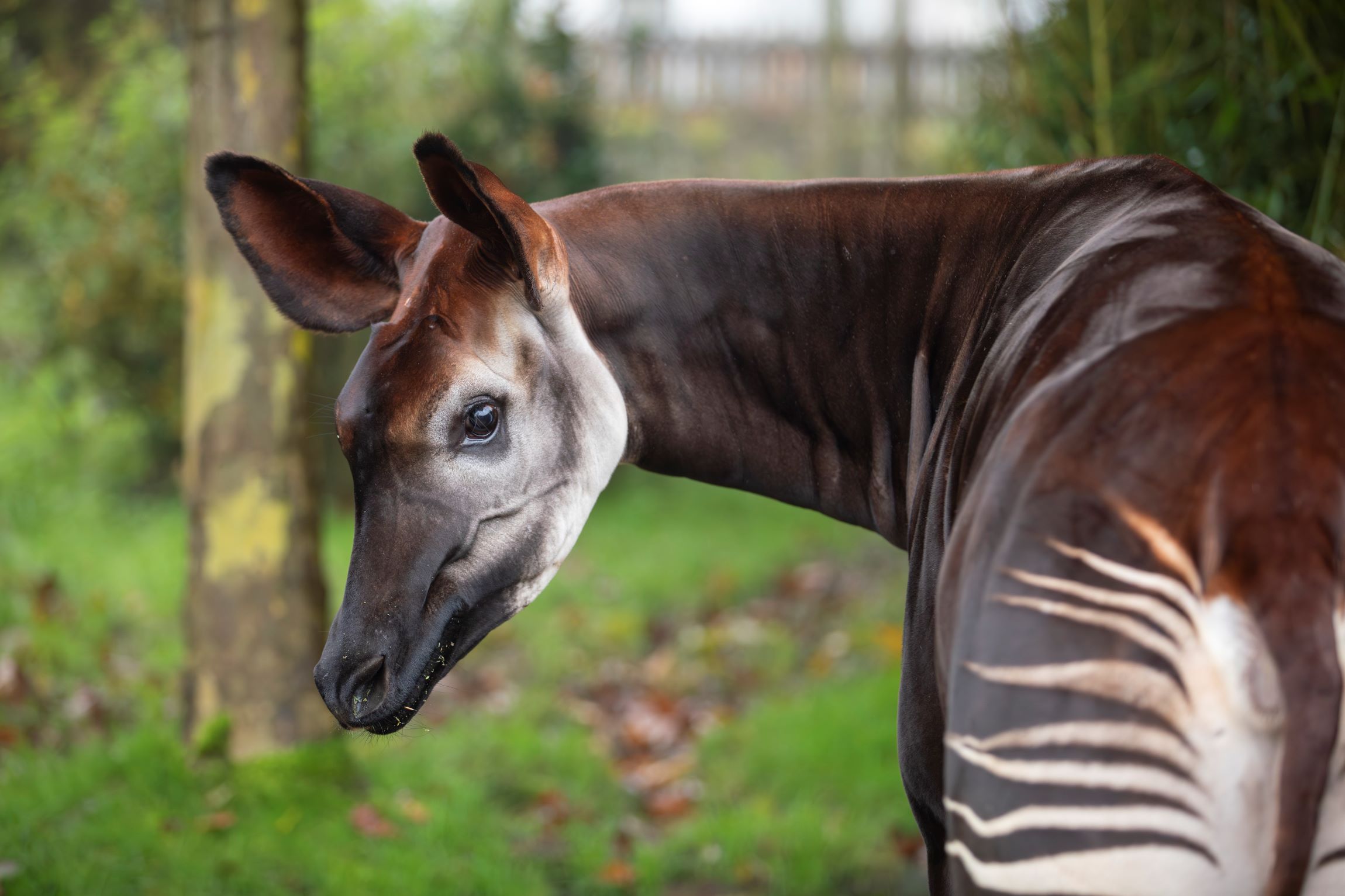
Quinta
Beauval Nature is working to protect okapis in the Democratic Republic of the Congo
This birth provides a wonderful opportunity to raise awareness of the okapi and the threats it faces. Endemic to the tropical forests of central and north-eastern Democratic Republic of the Congo, this close cousin of the giraffe is currently classified as ‘Endangered’ on the IUCN Red List. Habitat loss and fragmentation, poaching, logging and mining, as well as political instability, are placing significant pressure on wild populations.
Beauval Nature supports the Okapi Conservation Project, which operates within the Okapi Wildlife Reserve, in the heart of the Ituri Forest. In 2025, the programme notably strengthened the capacity of the Congolese Institute for Nature Conservation through a network of 50 informants reporting illegal activities and the deployment of camera traps.
The project also involves local communities. Training in agroforestry is offered to farmers, whilst the MARFO initiative supports nearly 300 women. Conservation messages have also been broadcast on eight community radio stations, and 700 students have been made aware of the issue at three universities.
Each new birth thus helps to draw attention to this iconic animal and to the essential actions required to protect its habitat.