World Orangutan Day: Raja is growing up, observing… and learning!
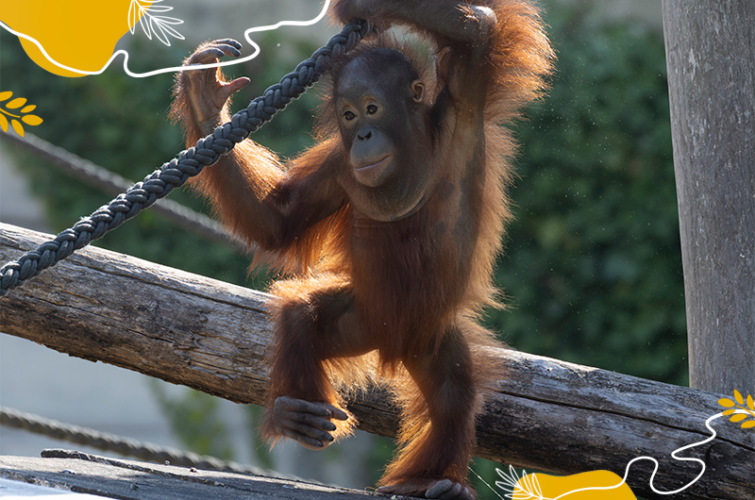
Just a few days after Raja’s third birthday, celebrated on 12 August, orangutans are once again in the spotlight with World Orangutan Day on 19 August.
At Beauval, our young male is growing before our very eyes. As energetic as ever, he is becoming more independent and, with each passing day, reveals a little more of one of his species’ greatest qualities: an astonishing capacity for observation and learning.
In the wild, these abilities are essential for thriving in a complex and changing environment. Orangutans today face numerous threats, ranging from the loss and fragmentation of their habitat to conflicts with human activities. In Borneo, the HUTAN organisation, supported by Beauval Nature, is working precisely to gain a better understanding of these great apes and to promote their coexistence with local communities.
Raja, three years old and already full of character!
Born at Beauval on 12 August 2023, Raja is the son of Manis and Tigu. He spends his days with his parents, as well as with Sabah and Nuninka, the group’s two other female Bornean orangutans.
And at three years old, Raja is bursting with energy! “A live wire”, according to his keepers. He plays a lot with his sister Sabah, but also with his father Tigu. He’s even started trying to bite him to encourage him to play… despite the fact that there’s a weight difference of around 80 kg between them! A fine example of the confidence he’s gaining as he grows up.
The young orangutan is also venturing further and further away from Manis to explore his surroundings. His mother, however, is never far away: as soon as a situation becomes uncomfortable, Raja knows exactly who to turn to for refuge. This growing independence also allows Manis to enjoy more moments of peace and quiet.
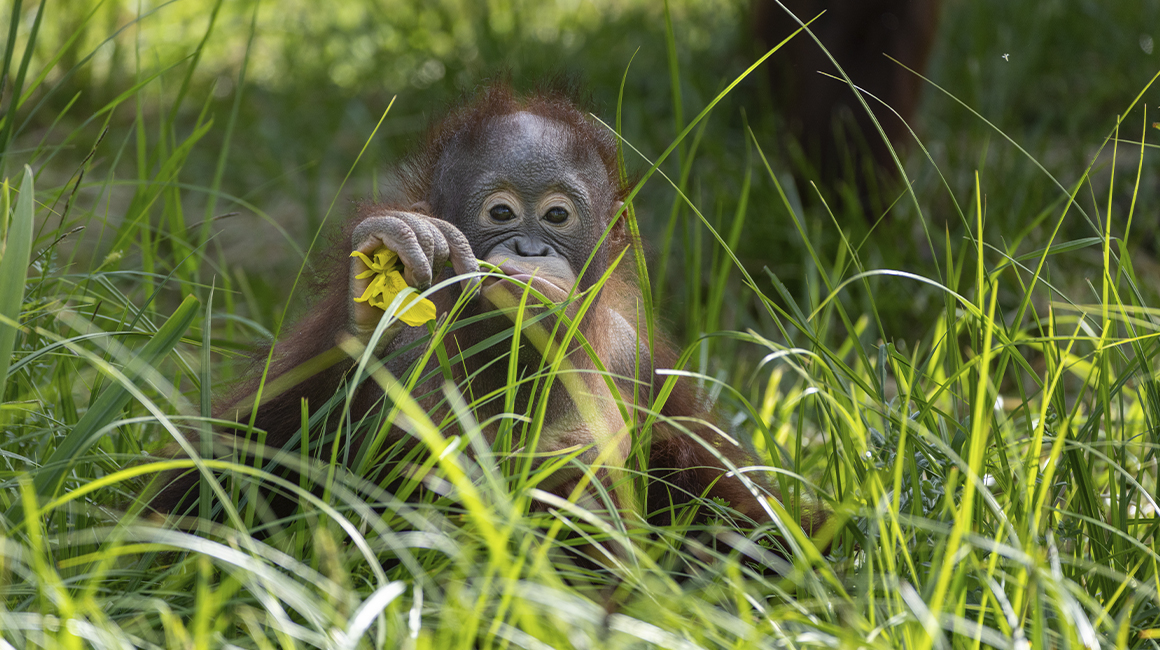
Raja is venturing further and further away from his mother Manis to explore his surroundings
This growing independence is an important milestone for orangutans. In the wild, young orangutans stay with their mothers for several years before becoming fully independent.
By discovering the orangutans at ZooParc de Beauval, everyone can gain a better understanding of the challenges facing their conservation and contribute, in their own way, to the protection of this iconic species.
I’m coming to see the orangutans
Raja, a young orangutan who learns by watching
Raja has a remarkably effective way of learning: watching others! The keepers have noticed that he is increasingly mimicking behaviours observed in the adults, including during medical training sessions. When another orangutan takes part in a training session, the young male follows every one of its movements closely. As a result, simply by observing his fellow orangutans, he learns much more quickly.
Even the art of building a nest is learnt through observation. Raja is currently copying the way his father, Tigu, builds his nest. This behaviour is far from insignificant: in the wild, orangutans build platforms out of vegetation on which they rest and spend the night.
Orangutans’ cognitive abilities are particularly well-developed. They are able to learn by observing and are even capable of using tools, such as a twig to retrieve insects or honey, or a branch to reach out-of-reach plants.
At the ZooParc de Beauval, this skill means the teams have to be extra vigilant. Patient and very dexterous, orangutans are particularly adept at taking things apart, undoing things… and finding that little loophole nobody had thought of!
Raja himself is starting to pick up some of his father’s habits. For example, when he feels the keepers aren’t moving fast enough, he makes little noises with his mouth to get their attention. Could impatience be hereditary?
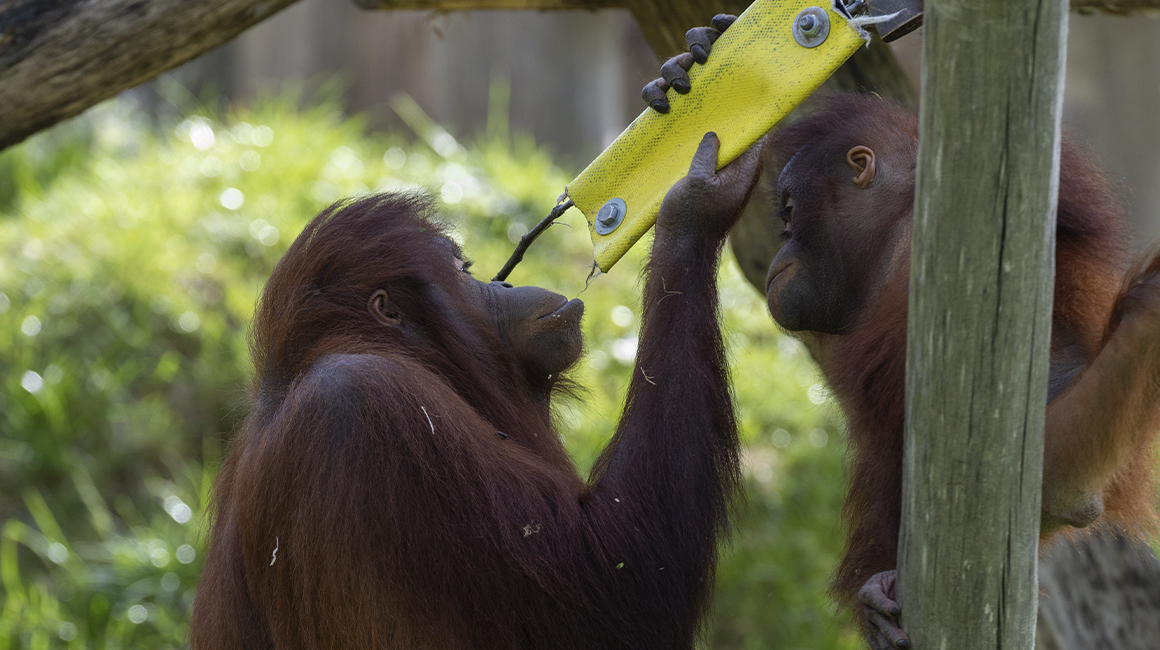
Sabah and Raja enjoying a food enrichment session
The orangutans at Beauval: particularly resourceful animals
Raja isn’t the only one to show ingenuity. Since the refurbishment of their island in early 2025, the orangutans have been making the most of the new structures.
Manis doesn’t hesitate to climb right to the top of the climbing frames, whilst the group digs, brings back stones or loosens the ropes. In other words: the facilities are being inspected very carefully!
Dietary enrichment activities also continue to be a great success. Fruit and cooked potatoes are among the group’s little treats. Raja, for his part, has a very clear preference: peppers remain his favourite treat.
And when an enrichment activity requires a bit of thought, everyone has their own strategy. The females often prove to be meticulous and patient. Tigu, for his part, sticks to a well-honed technique: letting the others do the work… before coming along to claim the reward! A habit that has been observed for some time now at Beauval.
An artistic experiment also held a little surprise for the keepers. Chalk was offered to the group so they could draw. Nuninka joined in the fun. The others? They clearly found the chalk more interesting to taste than to use!
In the wild, the orangutan is a critically endangered species
Behind this fascinating behaviour, however, lies a much more worrying reality.
There are three species of orangutan: the Bornean orangutan (Pongo pygmaeus), the Sumatran orangutan (Pongo abelii) and the Tapanuli orangutan (Pongo tapanuliensis). At Beauval, the group belongs to the Bornean species, recognisable in particular by its generally darker coat, which can vary from orange to chocolate brown.
The Bornean orangutan is classified as ‘Critically Endangered’ on the IUCN (International Union for Conservation of Nature) Red List, and its populations are in decline. Deforestation and forest fragmentation are major threats. Logging, mining and agricultural development are transforming their habitat, particularly through the expansion of oil palm plantations.
Added to this are conflicts with humans, poaching and the illegal trafficking of young orangutans. These losses are particularly difficult to offset for a species with an extremely slow reproductive rate: on average, a female gives birth to just one baby every 6 to 8 years.
Protecting orangutans also helps to preserve an entire ecosystem. As heavy fruit-eaters, they disperse numerous seeds as they move about, thereby helping to renew the forests.
Find out more about orangutans
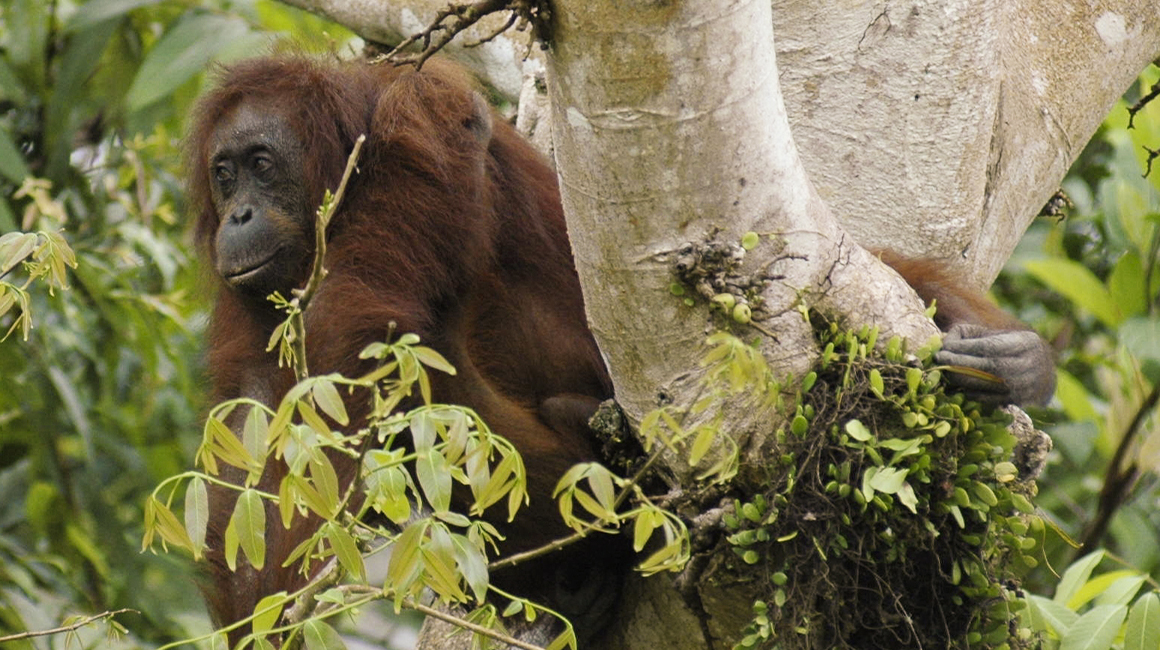
Orangutan spotted in Borneo ©HUTAN
HUTAN: new methods to protect orangutans
It is in Sabah, on the island of Borneo in Malaysia, that the HUTAN organisation is working to protect orangutans and other species living around the Kinabatangan River. This programme is supported by Beauval Nature. The work carried out in this region is, in fact, taking on a new dimension: the lower Kinabatangan was designated a biosphere reserve by UNESCO in 2025.
In the field, the teams are constantly seeking to gain a better understanding of the orangutans. In 2025, HUTAN developed a new census method: drones fitted with thermal cameras are used at night to detect orangutans in their nests. Expeditions were also carried out in various national parks to document the conservation status of orangutan populations and other species.
Protecting the species also involves restoring its habitat and connecting the various forest fragments. In 2025, the teams continued to maintain the 70,000 saplings planted in 2024. They also maintained five bridges enabling orangutans to cross certain gaps in their habitat and built a new structure within a palm plantation.
Finally, HUTAN continues to monitor the orangutans that frequent oil palm plantations in order to better understand their movements and minimise conflicts with human populations.
A key issue: orangutans are capable of adapting to landscapes altered by human activities, provided that forested areas remain accessible and connected. Maintaining corridors between them allows the animals to move about and helps prevent populations from becoming isolated.
How can you help protect orangutans?
To mark this World Day, everyone can play their part in preserving orangutans and their habitat. By choosing products certified by the RSPO for palm oil or by the FSC and PEFC for timber, you can support more environmentally friendly supply chains.
You can also support Beauval Nature’s work by sponsoring the Beauval orangutan group. Your donation goes directly towards funding biodiversity conservation programmes.
And on your next visit, keep your eyes peeled! You might spot Raja imitating one of Tigu’s gestures, Manis carefully inspecting what you’re carrying in your bag, or Nuninka getting stuck into an enrichment activity… One thing is certain: with their curiosity, patience and intelligence, the orangutans at Beauval always have wonderful surprises in store for you.
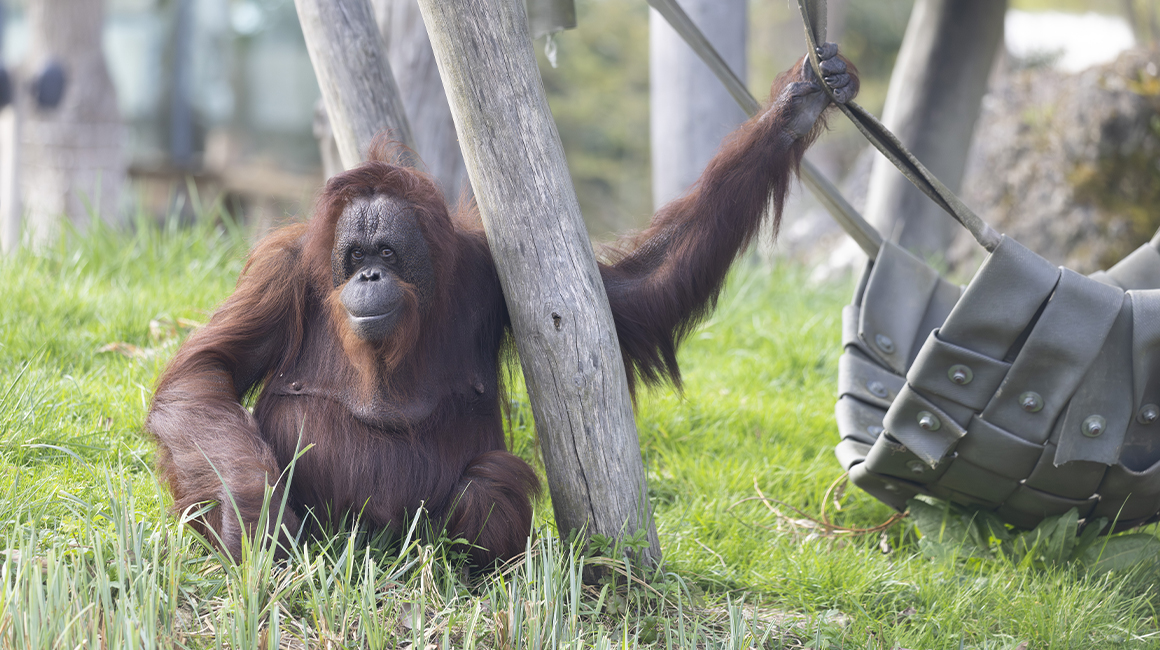
Nuninka, one of the female orangutans at ZooParc de Beauval
Everything you need to know about orangutans
Why do orangutans stay with their mothers for so long?
Young orangutans spend several years with their mothers. This long learning period enables them to acquire all the skills essential for their survival: building a nest, recognising seasonal fruits, moving through the trees and avoiding danger. They generally become independent at around 7 or 8 years of age.
Why are orangutans at risk of extinction?
Orangutans are mainly threatened by the destruction and fragmentation of their habitat, caused in particular by deforestation. They are also victims of poaching, illegal trafficking and conflicts with human activities. As females give birth to only one baby every 6 to 8 years, their populations recover very slowly.
Why are orangutans important for the forest?
Orangutans play a vital role in the regeneration of tropical forests. By eating large quantities of fruit, they disperse seeds as they move about, thereby helping to regenerate the vegetation. Their disappearance would therefore have consequences for the entire forest ecosystem.