World Parrot Day: discover the secrets of these iconic birds
Parrots: this is a term that encompasses far more species than meets the eye. They all belong to the order Psittaciformes, which includes macaws, Amazon parrots, parakeets, cockatoos and lorikeets, amongst others.
But behind their myriad colours, these iconic birds are nonetheless under threat. To mark World Parrot Day, established in 2004 by the World Parrot Trust, we invite you to (re)discover their diversity, their unique characteristics… and the measures put in place to protect them.
Psittaciformes: a diverse range of birds across the southern hemisphere
There are now more than 400 species of birds that can be classified as Psittaciformes. What do they have in common? A hooked beak and zygodactyl feet… which means that each foot has two toes facing forwards and two facing backwards.
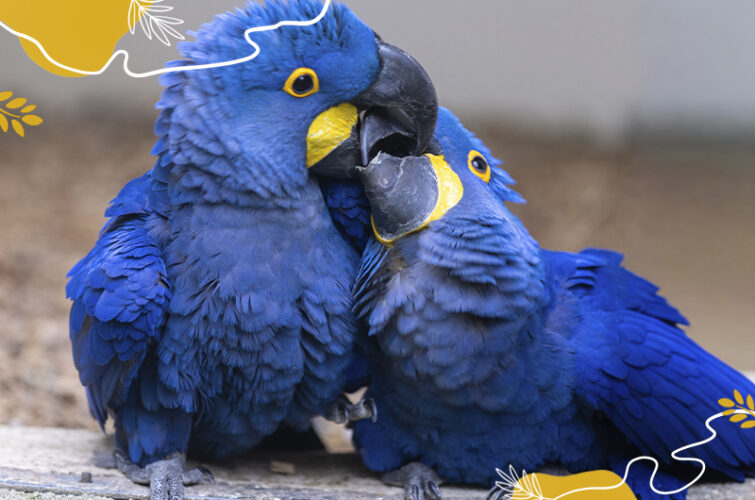
During your visit to Beauval, you’ll be able to discover nearly forty species belonging to this order. Among them is the hyacinth macaw, which is being celebrated by the World Parrot Trust on this World Parrot Day. Known as the largest of the parrots, it is recognisable by its uniform blue plumage and a few bright yellow patches on its head. Nevertheless, the Psittaciformes, in all their diversity, have plenty more surprises in store: let’s set off to discover all the species you can see at the ZooParc, in the heart of the Parrot Rotunda, or during our immersive experience, Les Maîtres des Airs!
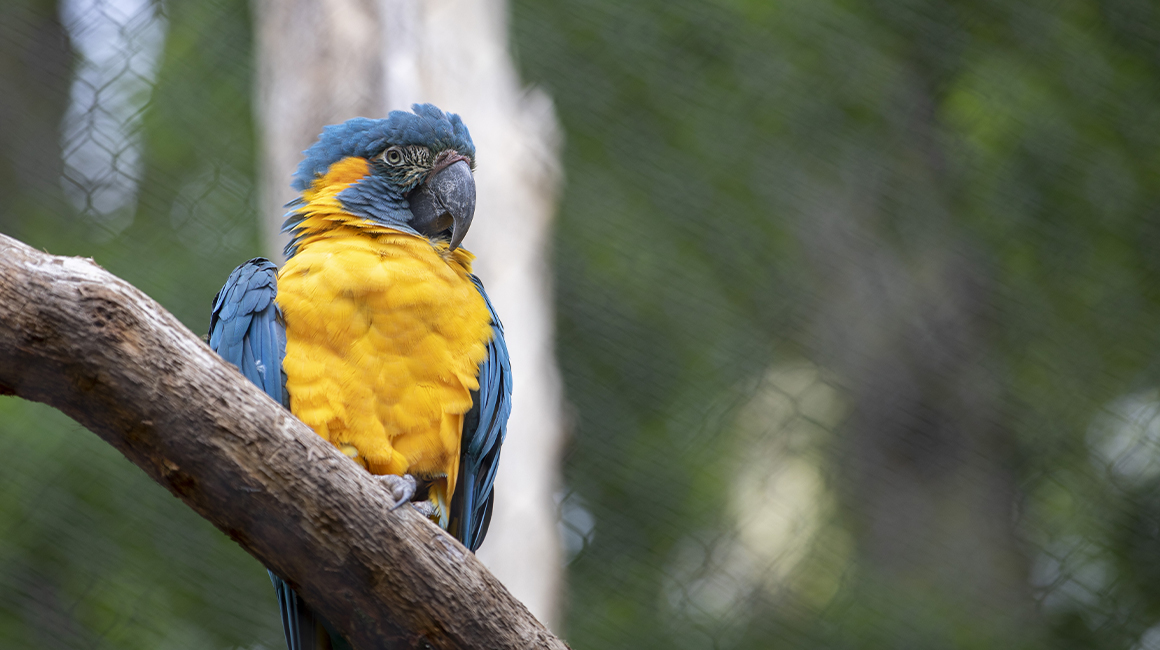
Blue-throated macaw
Macaws
Macaws are probably the most recognisable of all parrots. With 17 different species, they are all found on the American continent and can measure up to a metre in length! At ZooParc, as well as the hyacinth macaw, you can see:
- The scarlet macaw (Ara macao), almost entirely red with shades of yellow, green and blue;
- The green-winged macaw (Ara chloropterus), similar to the scarlet macaw but without the yellow feathers;
- The blue-and-yellow macaw (Ara ararauna), recognisable by its blue, green and yellow feathers;
- The blue-throated macaw (Ara glaucogularis), similar to the blue-and-yellow macaw, with the top of the head and cheeks entirely blue;
- The Buffon’s macaw (Ara ambiguus), mainly green with a red band across the forehead;
- The Lafresnaye’s macaw (Ara rubrogenys), green with touches of orange-red and azure blue;
- The Coulon’s macaw (Primolius couloni), olive-green with a blue head and a narrow black stripe across the forehead.
Amazon parrots
Amazon parrots are recognisable by their green plumage; measuring 45 centimetres on average, they are also found on the American continent. During your visit to ZooParc de Beauval, you can discover:
- The Green-cheeked Amazon (Amazona viridigenalis);
- The Cuban Amazon (Amazona leucocephala);
- The blue-cheeked Amazon (Amazona brasiliensis);
- The Yellow-shouldered Amazon (Amazona barbadensis).
Lorikeets and lorises
Generally small and slender, lorikeets and lorises can measure up to 30 centimetres on average. Feeding mainly on nectar, they are found in South-East Asia and Oceania. Here are the species you can see at Beauval:
- The red-necked lory (Trichoglossus rubritorquis);
- The rainbow lorikeet (Trichoglossus moluccanus);
- The Coquette Lorikeet (Charmosyna placentis);
- The Papuan lory (Charmosyna papou);
- The Lady’s lorikeet (Lorius domicella).
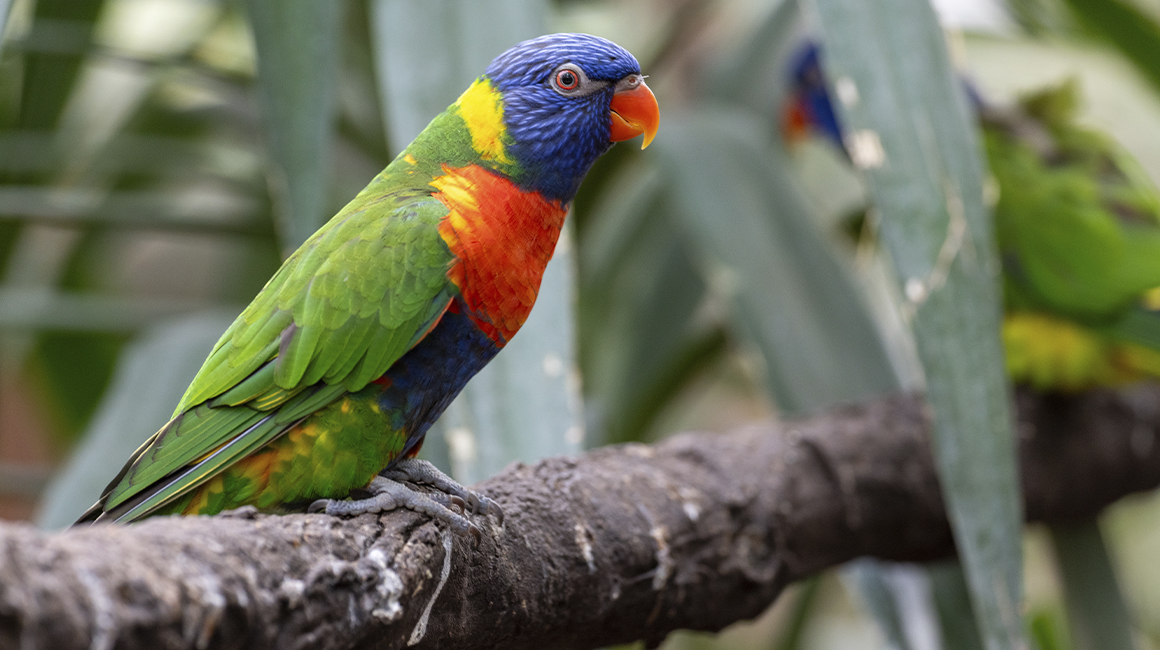
Rainbow lorikeet
Parakeets and conures
The terms parakeets and conures cover a wide variety of species native to the Americas, Africa, Asia and Oceania. Often slimmer and more slender than Amazon parrots, they feed mainly on seeds, fruit or plants. You can see the following species at Beauval:
- The blue-headed lorikeet (Loriculus galgulus);
- The Black-cheeked Lovebird (Agapornis nigrigenis);
- The Derby parakeet (Psittacula derbiana);
- The Latham’s parakeet (Lathamus discolor);
- The Patagonian parakeet (Cyanoliseus patagonus);
- The Tiriba parakeet (Pyrrhura cruentata);
- The Sun Conure (Aratinga solstitialis);
- The golden conure (Guaruba guarouba).
Cockatoos
Recognisable by their crests, the tufts of feathers they can raise on their heads, cockatoos are found in South-East Asia and Oceania. At Beauval, you can see:
- The black cockatoo (Probosciger aterrimus);
- The rose-billed cockatoo (Eolophus roseicapilla);
- The Banks’ cockatoo (Calyptorhynchus banksii);
- The Leadbeater’s cockatoo (Cacatua leadbeateri);
- The Yellow-crested Cockatoo (Cacatua galerita triton);
- The orange-crested cockatoo (Cacatua citrinocristata).
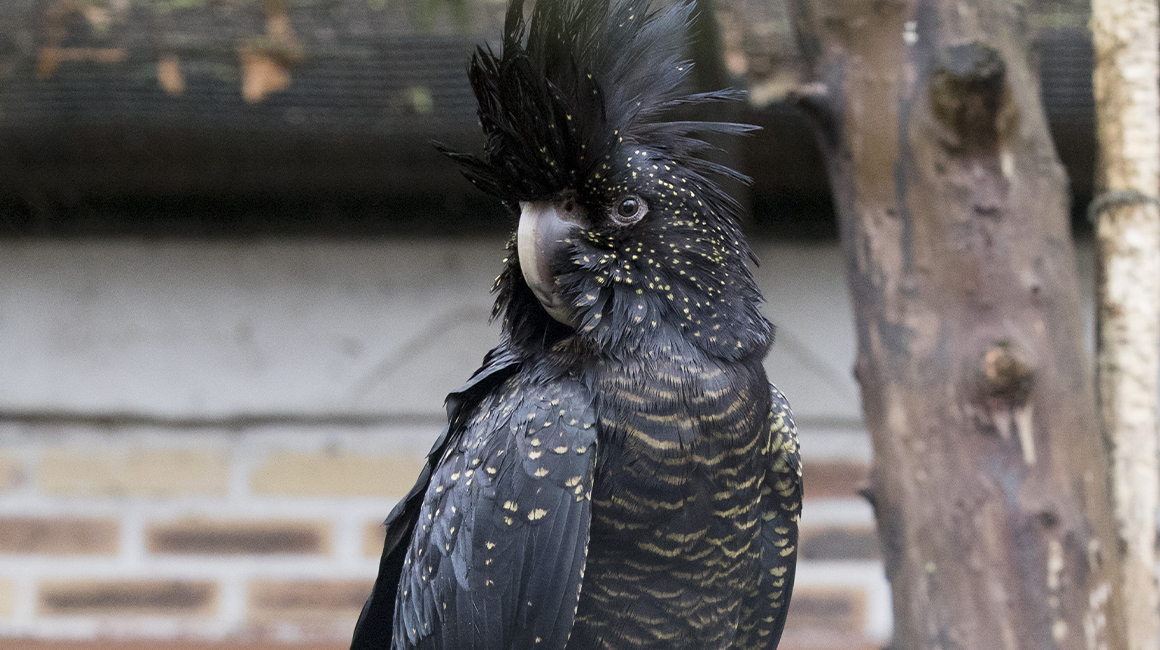
Banks’ cockatoo
Other parrots
Some species on display at the ZooParc de Beauval belong to very specific groups that are difficult to classify within the major parrot families such as macaws, Amazon parrots or parakeets. Often unique in their own right, they possess very specific characteristics. This is the case with:
- Pesquet’s parrot (Psittrichas fulgidus), recognisable by the large featherless patch on its head, which gives it the appearance of a vulture. This feature prevents its feathers from getting dirty when it eats fruit.
- Gabon Grey Parrot (Psittacus erithacus), well known for its remarkable ability to mimic human voices. In the wild, a study has shown that it can mimic nine different species of birds and one species of bat.
- Black-headed parakeet (Pionites melanocephalus), a small parrot renowned for its particularly playful and energetic behaviour. Unlike conures, which are more aerial and slender, parakeets often move by hopping from branch to branch and spend a lot of time climbing using their beaks.
- Mottled Parrot (Deroptyus accipitrinus), recognisable by the feathers surrounding its head, which can be ruffled to form an impressive crest during courtship displays or to defend its territory.
- Kea (Nestor notabilis), found in the mountains of New Zealand’s South Island. Nicknamed the ‘mountain clown’, it is very curious and examines everything that comes its way: it can even dismantle windscreen wipers and wing mirrors in record time!
- The Eclectus Parrot (Eclectus roratus), which displays one of the most spectacular examples of sexual dimorphism among parrots. At a glance, it is indeed possible to tell the males and females apart: the males have mainly green plumage, whilst the females are predominantly bright red.
- The Vasa Parrot (Coracopsis vasa), a parrot native to Madagascar with highly unusual breeding behaviour. Unusually for birds, the male actually develops an external copulatory organ during the breeding season!
Ambassadors of the tropics to be protected
Parrots are undoubtedly the most iconic of our planet’s tropical birds. Yet they are now under threat: deforestation, as well as the trafficking of endangered species, are the main factors undermining the populations of these various birds.
Moreover, whilst parrots are highly sought-after pets, they are also among the most frequently abandoned. Their exceptional longevity (some macaws can live for over 80 years) and their noisy, playful nature make them sometimes difficult lifelong companions, with specific needs that their owners cannot always meet.
In this context, it is the Gabon grey parrots that are the most popular of these pets. Between 1982 and 2001, more than 1.3 million wild individuals were captured for the international market, with 30 to 66 per cent of them dying before reaching it. Since then, these exports have been reduced thanks to the restrictions put in place, but also due to declining populations.
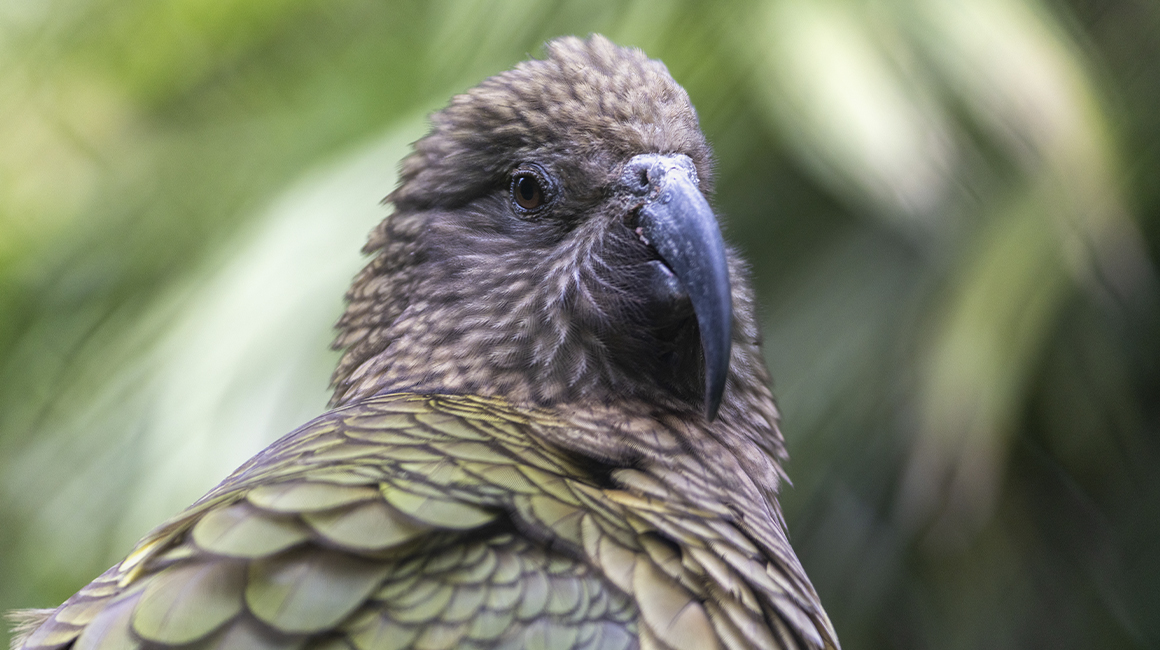
Kea
To work towards the conservation of these essential species, the ZooParc de Beauval and its association, Beauval Nature, are committed to the cause. Within our teams, Laetitia Latorre, Head of Science, Animal Species and Conservation, coordinates the EAZA Ex-Situ Programme for the black cockatoo, whilst Laure Pelletier, Zoological Director, coordinates the programme for the Philippine cockatoo. In practical terms, this means they oversee the management of European populations of these species, with a view to promoting genetic diversity and the long-term survival of these cockatoos in zoos. The coordinators are supported by teams of specialists, organised around a particular species or group of species: these are the Taxon Advisory Groups (TAGs). Laure Pelletier herself is vice-chair of the TAG dedicated to parrots!
But our work extends beyond the park: our association, Beauval Nature, actively supports the Philippine cockatoo conservation programme run by the Katala Foundation. As part of this, teams on the ground help monitor populations, encourage breeding by installing artificial nests, rehabilitate and release injured birds, and work on reforestation, with over 24,000 trees planted by 2025, amongst other initiatives. Patrols also covered more than 10,700 km that same year to look after these birds and their habitat. Today, this cockatoo—one of the most endangered on the planet—is seeing its numbers increase: a ray of hope for the conservation of endangered species!